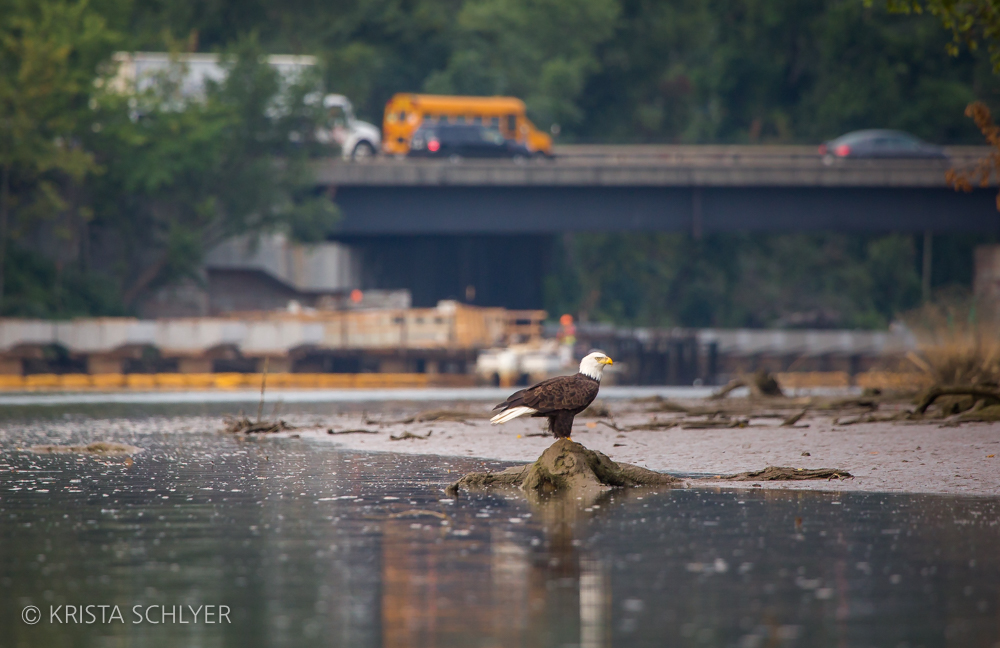
The Bluejacket’s Manual

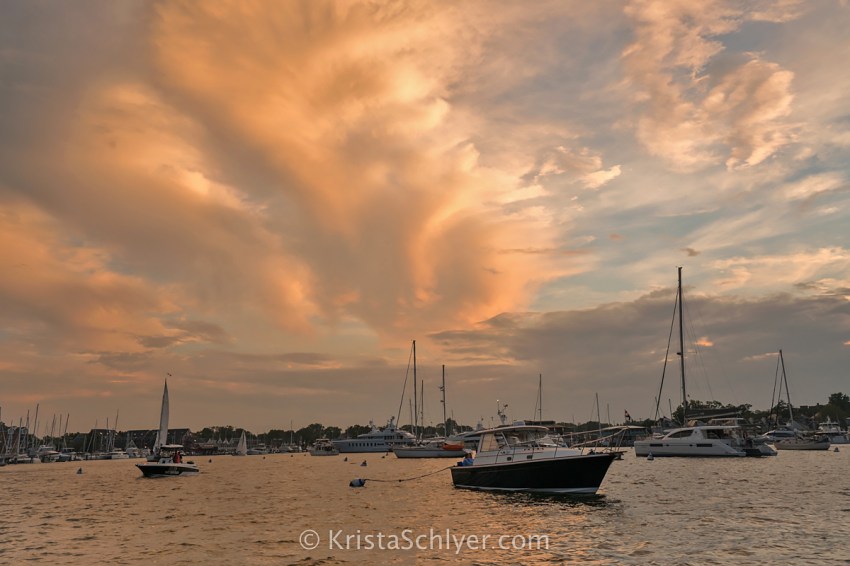
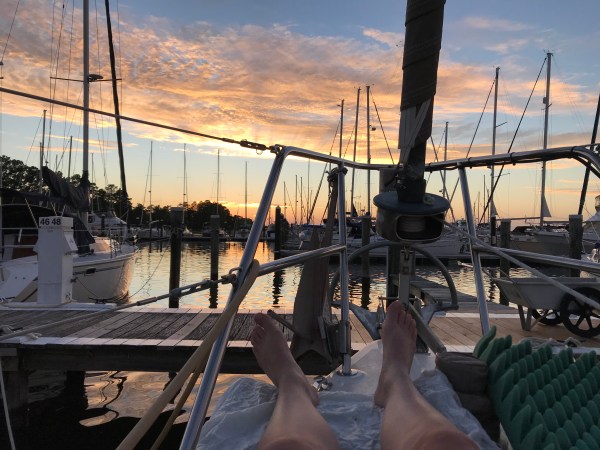
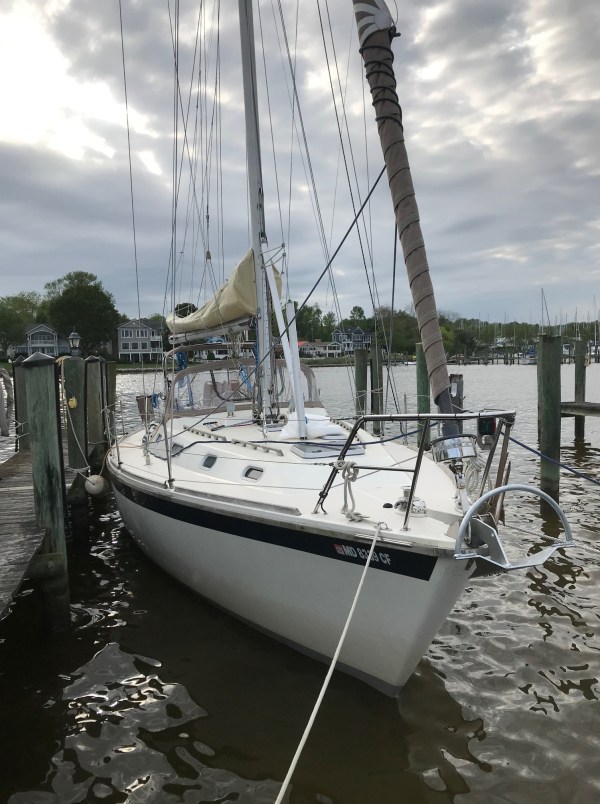
Spa Creek, Annapolis.

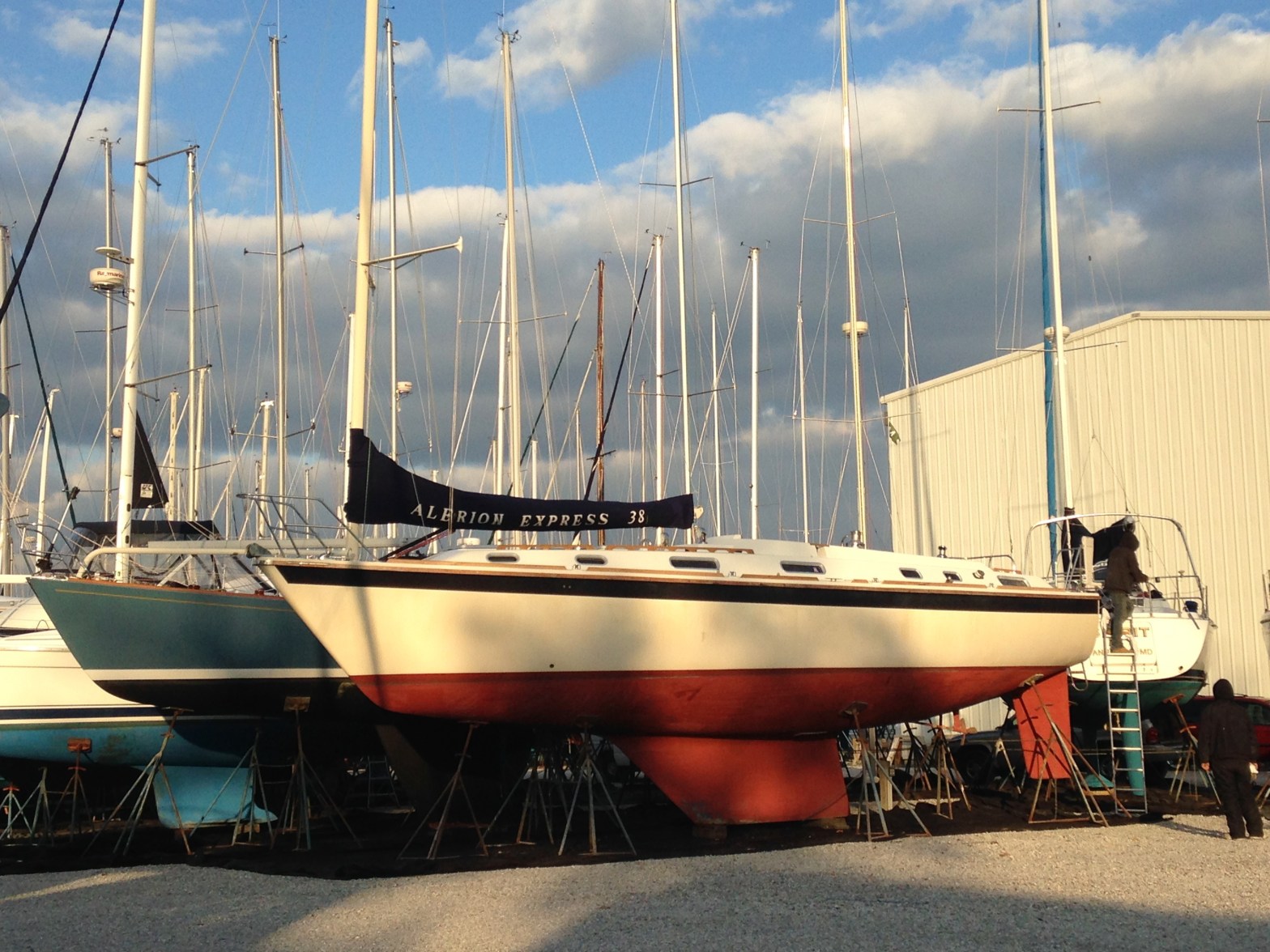
Betwixt wind and water: That portion of the hull that can be above or below water, depending on the angle of heel.

The Bluejacket’s Manual

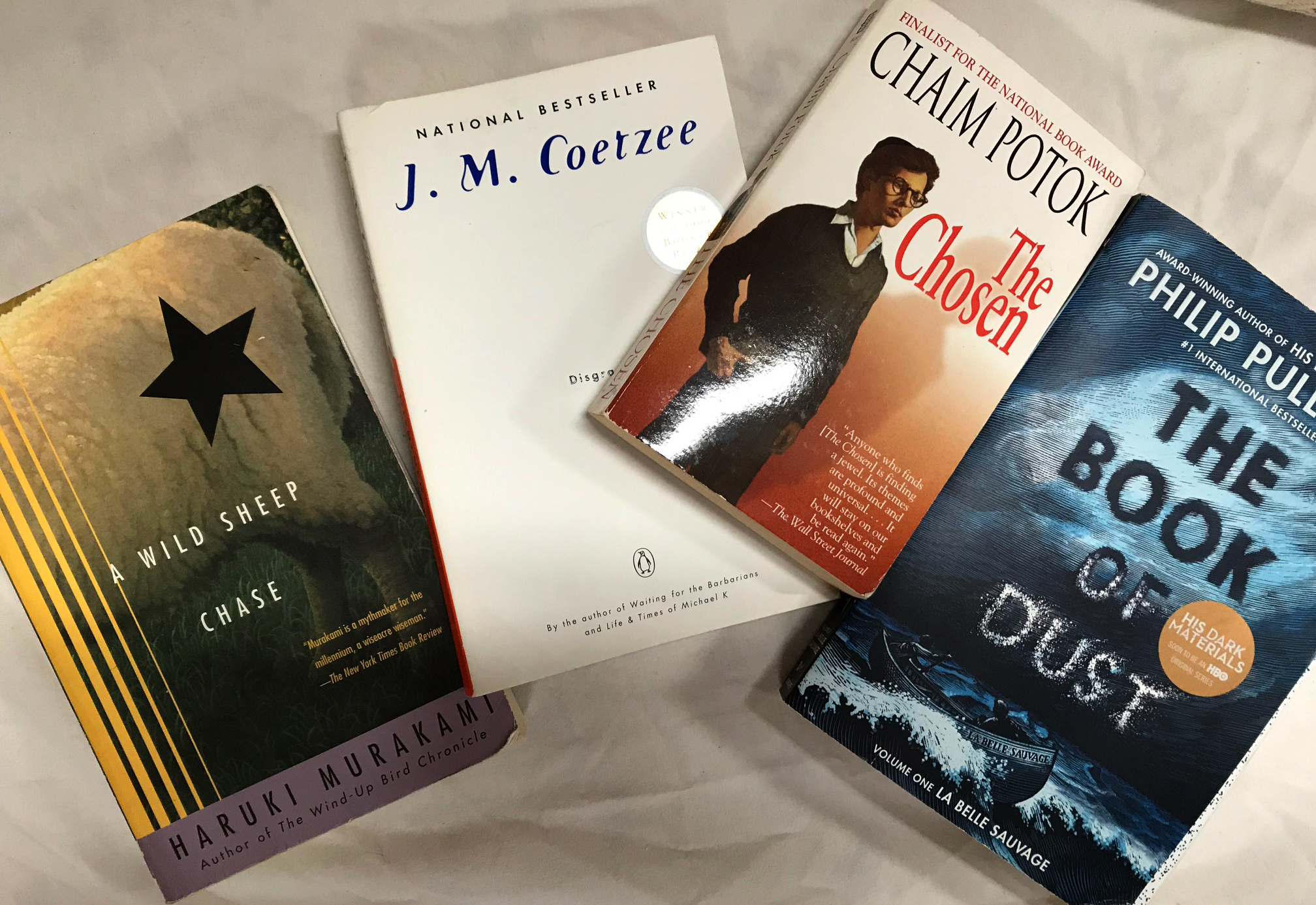
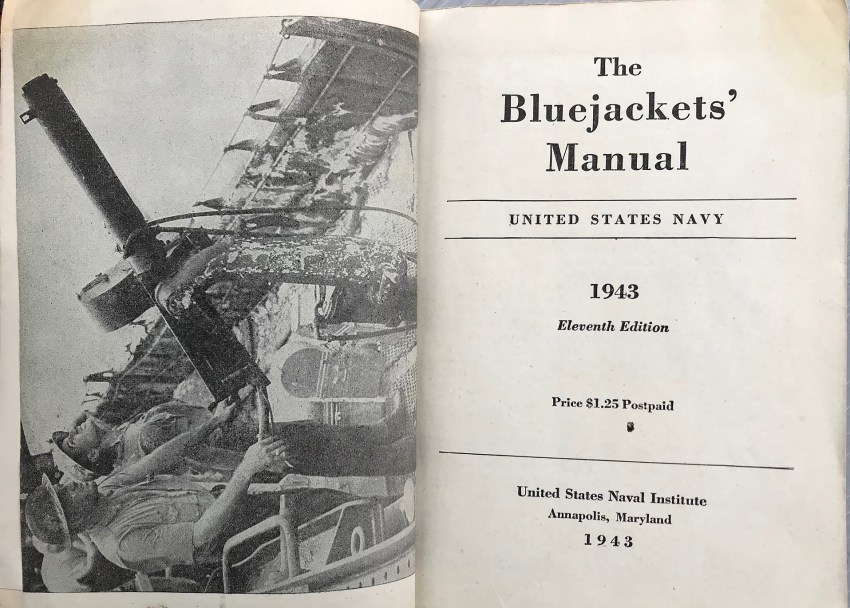
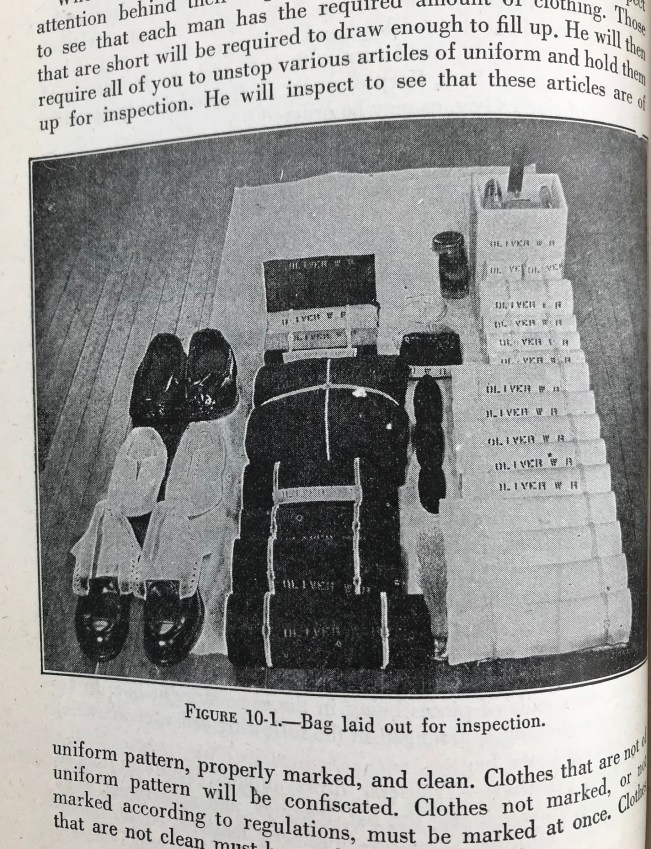
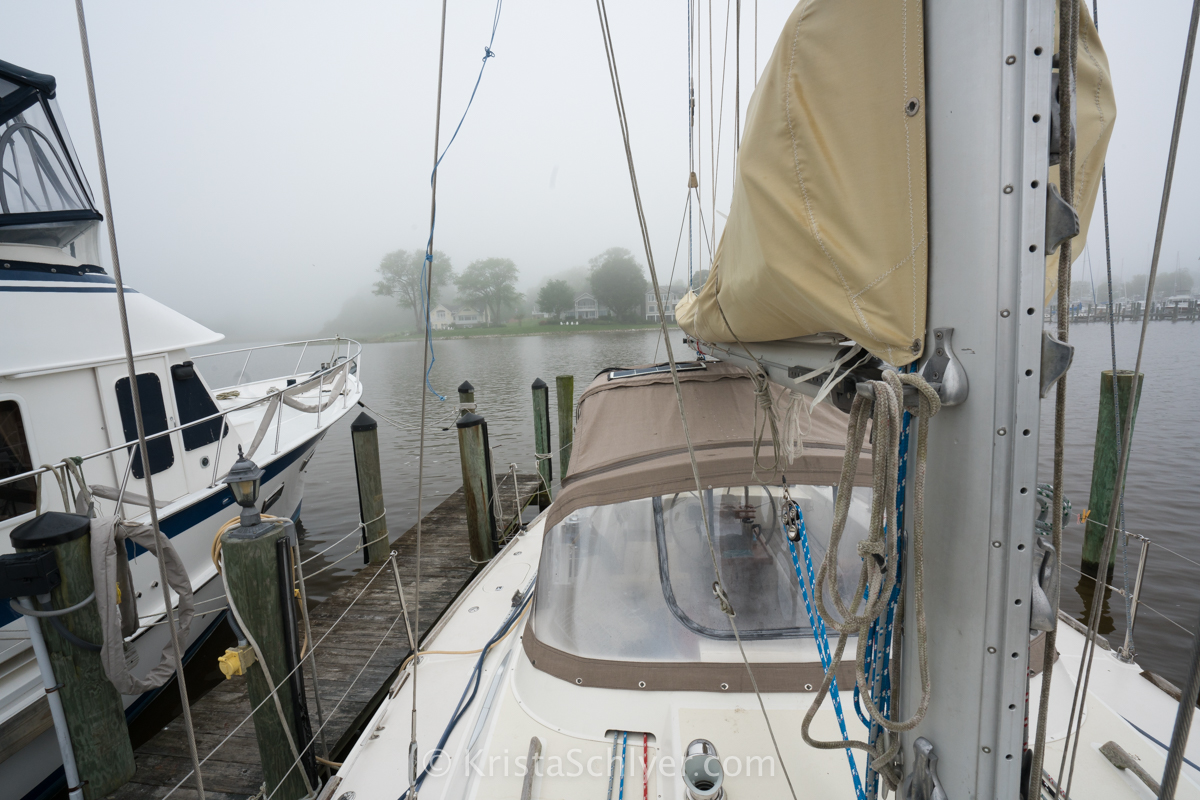
On Spa Creek in Annapolis, I watch the sun rise and listen to gulls lending their unruly voices to the morning reveille being bugled from the US Naval Academy. Maggie May sways on her mooring ball and  I sit with my morning coffee perusing a 1943 edition of The Bluejacket’s Manual, an instructional tome written to orient enlisted sailors for life in the US Navy during the second world war. It belonged to my grandpa.

My brother Nick gave me the book one Christmas after Bill and I announced our plans to sail around the world. Nick had followed in my grandpa’s footsteps, enlisting in the Navy in the late 1980s—serving at a different time, in a different war. I will return the book to him one day after it has been around the world or at least around the sun a few times as part of the orbit of items that live within Maggie May. For now, the book sits in an honored location next to Original Maggie May’s ashes and an angel bookmark that was my granny’s. 

This week we have been stationary in Annapolis while Bill studies for the Captain’s exam at the Annapolis School of Seamanship and we get some projects done on MM, including yet another repair to the mainsail. This one, thankfully, is a much smaller rip that happened when the sail got caught on one of the reefing hooks. An unpleasant surprise, but pale in comparison to what has come before.

While Bill is in class all day long, I am working on my own studies and projects and leafing through Grandpa’s manual, written more than 60 years ago, much of it right here in Annapolis. Grandpa died when I was around 10 years old. I still have clear memories of a gentle but orderly man who made duty, responsibility, family and discipline the foundations of his life. I wish I could have known him longer, but reading this manual effectively connects us through time, space and the sea. 

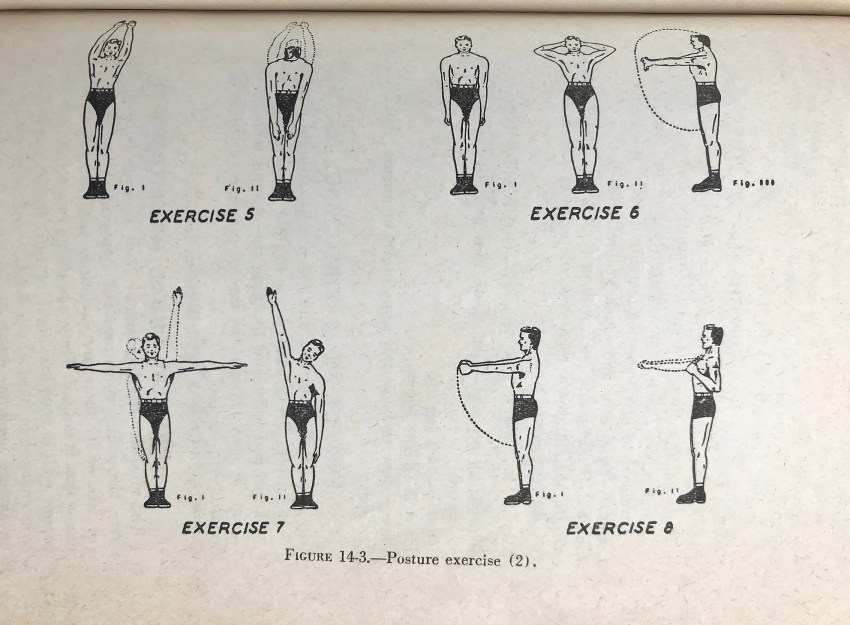
The book is more than 1000 pages and it covers every aspect of being a member of this branch of the armed forces, from how to serve with distinction upon the sea, to how to kill and how to avoid being killed. There are sections on duty, discipline, advancement, retirement, hygiene, and seamanship. Some of it reflects a past that, while distant in time, remains all too near in the cultural psyche. All sailors are men, and all men are white. Also, if they are exercising they all wear French cut bikini-briefs. 

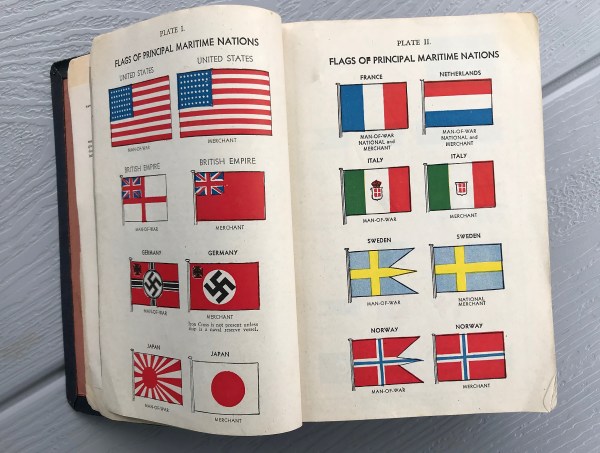
Germany has a swastika on its flag. The British flag is the flag of empire. 

The book is chockablock with information—I learned this term in the definitions section, along with betwixt wind and water and freshen the nip. I plan to work these into casual conversation with Bill, to ascertain whether his Captain’s Class was worth it. 

The Bluejacket’s Manual includes this proud fact: “Our Navy is as clean as any navy in the world.” Not the cleanest, but at least as clean. It contains this crucial advice: “The best type of bath is the shower”. Perhaps this bit was intended to help us gain a competitive edge over the other clean navies.

“Our Navy is as clean as any navy in the world.”

The Bluejacket’s Manual

The “Prophylaxis” section begins, “Bad women can ruin your bodily health.” There is no definition for bad woman. I am keenly interested. There is also information on how to chew your food—this topic comes up several times in the manual, which suggests there had been problems. There is a guide for how to fold your clothes the Navy way—this was mandatory with a guide for every type of garment and spot inspections to ensure that clothes were folded properly. Shoreside-me finds this hilarious; boat-me immediately begins planning an implementation strategy, knowing Bill will not buy into it. He will sit by and watch me refolding all my clothes, shaking his head quietly.  

The book is filled with lists (daily schedules in 15 minute increments, inventories of mandatory clothing items, procedures for launching the vessel and putting out fires, insight into the Navy’s chain of command). I can fully appreciate these lists, as there are dozens of things to be aware of at any given time when a boat is underway, and forgetting even one could put the boat and crew in jeopardy. 

For a sailor, The Bluejacket’s Manual of 1943 remains useful with tips on sail trim, knots, and navigation. Some of the thinking on these things has changed in the past decades, as has the style of underwear men do their calisthenics in, but since I don’t yet know enough to discern, I’ll probably suggest we try these techniques out.

My Grandpa must have read the entire 1145 pages, perhaps more than once. But he only marked one page, one single paragraph. It was about discipline, and said, in part: “A body of men which has good discipline is not subject to panic.” It doesn’t surprise me that if he was going to outline one paragraph, it would be this one. I am only now beginning to understand the critical role of self-discipline in warding off terror and panic. Later on, the manual advises, “It means to restrain your impulses.” For instance, the impulse to dive off the boat screaming when the vessel is bow-down in a 5-foot high breaking wave. I found another quote that is useful in this regard, the 1943 Navy’s definition of courage: “Courage is that quality which enables one to meet danger and difficulties with firmness and with ability unimpaired… It does not mean absence of fear.”

I can appreciate the manual’s advice on many topics, including how to get chocolate out of a uniform, though we don’t carry naphtha or chloroform on the boat, so I can’t actually try it out. I’m less interested in the advice that I should take a cold shower every day. And perhaps this is one bit of advice specific to a boat full of men.

As the sun rises higher in the sky I finish the last of my coffee, lay down my book, and get on with my chores for the day. I start by taking everything out of the V-Berth to find the source of an unpleasant odor. While Bill is at Captain’s Class, I’m working on a list of deeds that need doing to keep the SVMM in ship-shape. In the evenings, Bill tells me what he has learned, I outline what I have accomplished, we eat, head to our cozy berth and lay down betwixt sheet and mattress, betwixt wakefulness and sleep, betwixt gratitude and greasy hair. 

ONE LAST THING

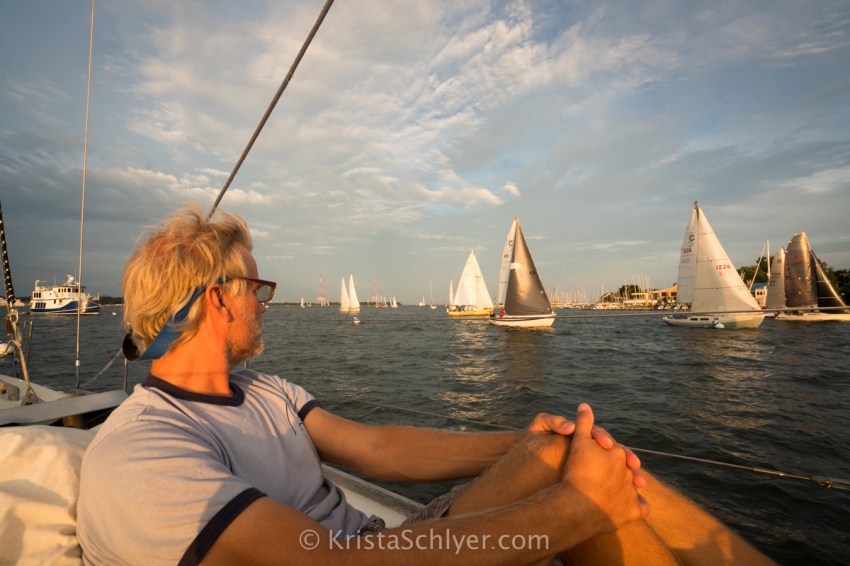
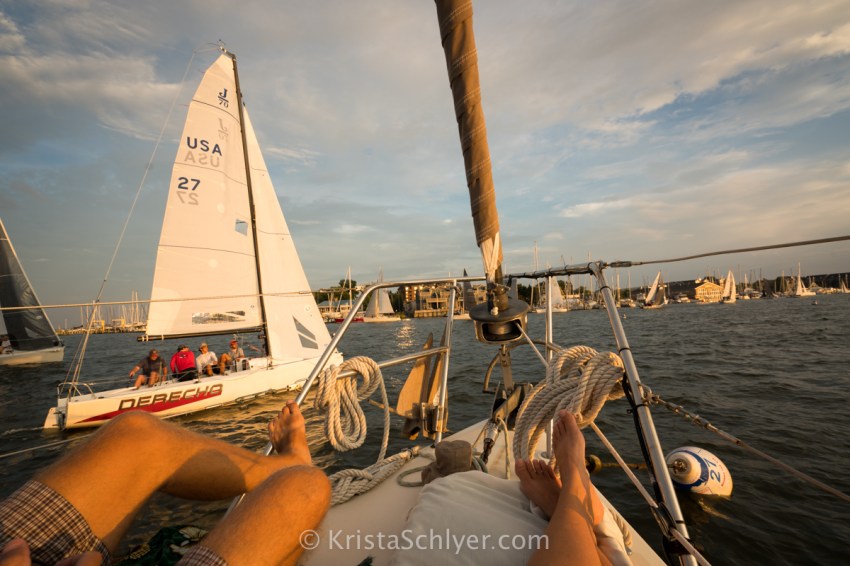
One night in Annapolis, we happened to catch the very last race of the Wednesday night summer sailing season out of Spa Creek. Purely by accident we moored our boat right in the middle of one of the craziest sailing spectacles in the country. The boats race on the Chesapeake Bay, but the final race of the night actually ends inside the mooring field in downtown Annapolis.

There were hundreds of sailboats, small and huge, all heading straight for us at full speed, then dodging our boat on last-minute tacks, racing to the finish line a hundred yards away. The sun was just about to set, lighting this magical moment with golden hue as Bill and I watched open-mouthed and breathless. It was some of the most incredible maneuvering either of us had ever witnessed so incredibly close. Bills summary: “This is the most amazing thing I’ve ever seen.” It was a good reminder, not all unforeseen events are bad. The future also holds unimagined and unimaginable surprise.

Thank you so very much to all of you who responded to my donation link on my last blog. And all of you who have supported this journey in any way. It is one of those unforeseen serendipities to find so much love and support in the world, my heart is chockablock.

Barnacle: An animal that is inclined to stick to a boat’s underside.

–The Bluejacket’s Manual

A Chesapeake Summer

Summer on the Chesapeake Bay, in five lines:

Hot, humid, thunderstorm.

Bald eagle tries to steal fish from osprey. Osprey crying out indignantly, loses fish.

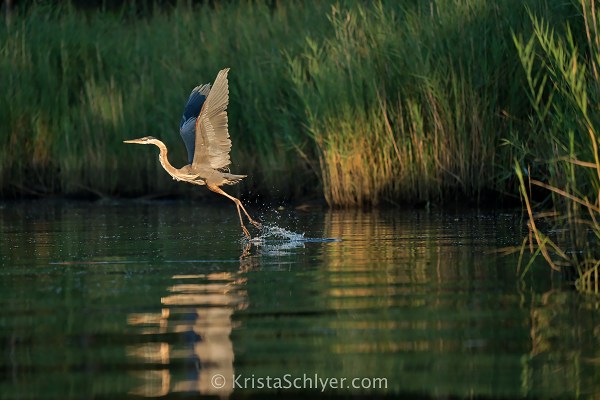
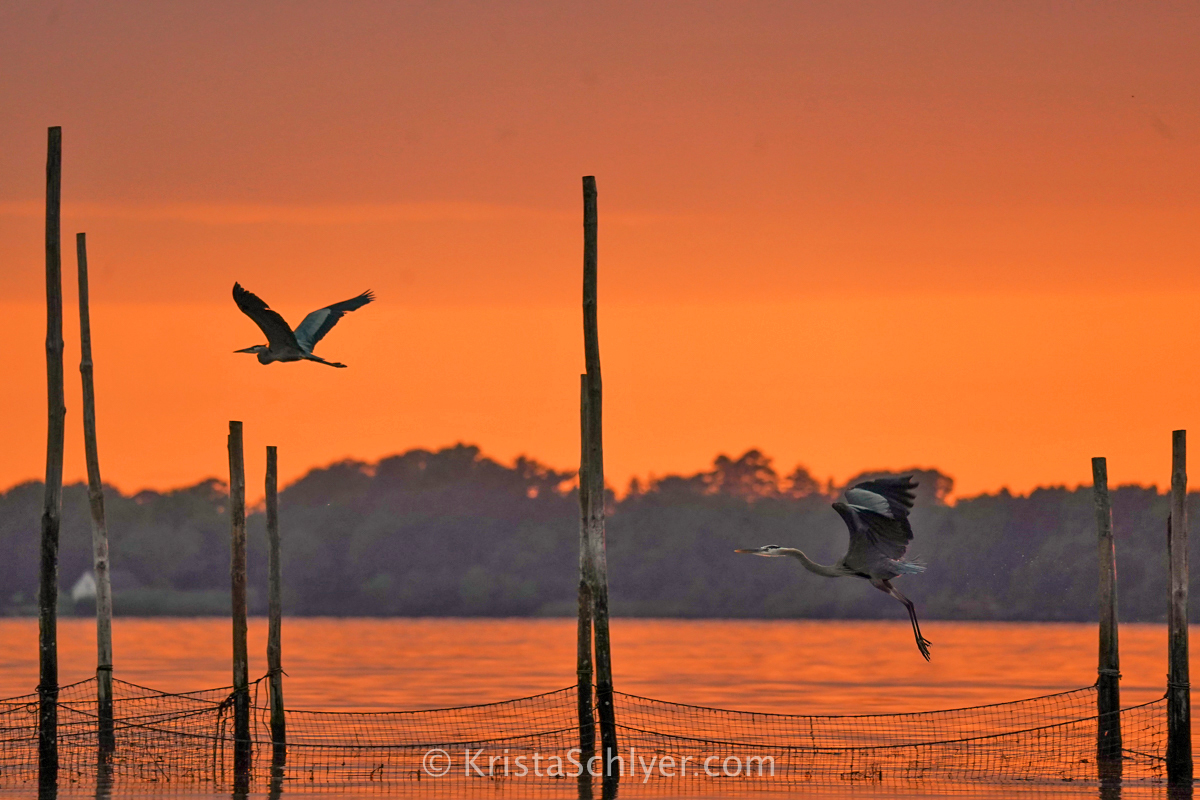
Great blue heron barks  at both of them, at no-one, at everyone and the general effrontery of the world.

Hot, humid, storm.

Jellyfish.

Great blue heron in the Eastern Neck National Wildlife Refuge on the Chesapeake Bay.

In a few more lines

Several days ago, at anchor near the Eastern Neck National Wildlife Refuge, dusk was quietly descending when Bill said, “Is there bioluminescence in the Bay?”

There wasn’t as far as I knew, but I went up on deck to see what he was seeing. A pale orange reflection of the dusky sky lay upon otherwise dark water. We watched and waited and presently there appeared a blue light. Then quick as a heartbeat it was gone. I wasn’t sure I hadn’t imagined it. 

“Am I seeing things?” Bill said. 

If so we are having the same delusion, I thought. We kept on watching as dusk faded to dark.  There was another pulse of blue light, floating along the side of Maggie May, and another, and another. Disks of pale blue, about the size of my open hand, drifting along with the tidal current, turning on, turning off. Bill and I sat in rapt audience.

We were the only boat in sight near the wildlife refuge, where wetlands and coastal forest cover the land and protect the water community, offering a haven to bald eagles, herons, gulls and terns, little snakes, blue crabs, and apparently bioluminescent jellyfish. This was my guess, as I had read somewhere that some jellyfish could illuminate in this way. The lights seemed to move in the manner of a jelly, kind of haphazard, without any apparent intention other than as a silent passenger upon the prevailing current. Utterly without aspiration they seem, like a dimly lit shadow of some listless being, but also radiating a profound passive grace. And full of blue surprise.

Bill looked up “bioluminescence” and “Chesapeake Bay”, and sure enough, there are several forms these watery lights can take, from the bacteria that lights the water itself at certain times and in certain places, to jellyfish.

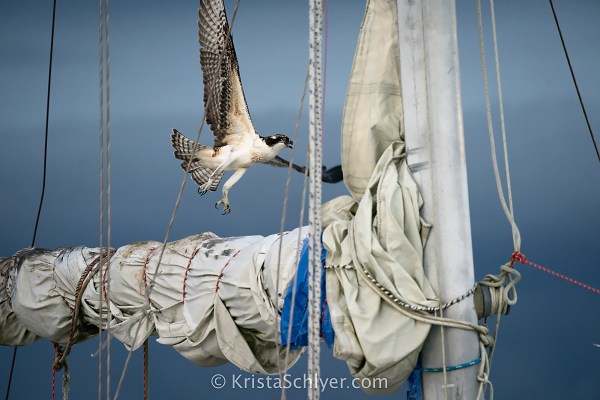
Osprey on an abandonner sailboat in Swan Creek.

Living on a boat in summer in the Chesapeake, one hopes for such gentle wonder to distract from the heat, flies, not nearly enough wind for sailing or far too much from frequent storms. And the pollution.

The Chesapeake has made great improvement in the past decades, thanks to efforts by thousands of individuals and organizations and regulations that are leading us toward the right track. But it is still a deeply wounded ecosystem, as is its sub watershed the Anacostia River, and for many of the same reasons. Reasons that date back to Captain John Smith, herald of environmental and cultural woe for the Bay 400 years past. 

When we decided to stay in the Chesapeake through hurricane season, I did some research into the healthiest waters of the bay, hoping to find someplace we could swim and cool off without worrying too much about one of us getting another skin infection, or worse. Such info is not easy to find. There are sites that list which beaches generally pass water quality tests that indicate the water is healthy enough to swim in. But even these waters after a rain and through much of the summer can carry dangerous bacteria and viruses. The ecology of the bay has been too deeply eroded over too long a period. 

I found a site created by the Maryland Department of Natural Resources that mapped the state’s “Tier 2” waters. This Orwellian term is the official designation for the 253 relatively healthy streams, many of which lie within the greater Chesapeake Bay watershed. Most of these are not on the bay itself, but up in the smaller creeks. By the time their waters reach the bay, they have mixed with the foul runoff from farms, roads, and cities with antiquated sewer and stormwater systems. As a rule, healthier waters are not accessible by a sailboat. Most are nestled in some swath of natural land that has escaped the fate of most of the Mid-Atlantic region: becoming a shopping mall, housing development, urban area, agricultural or industrial development, or sporting complex.

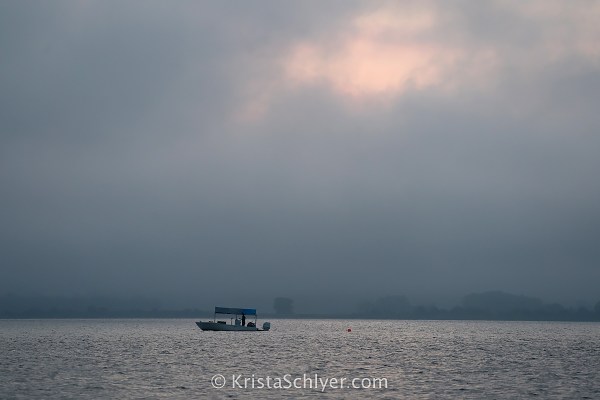
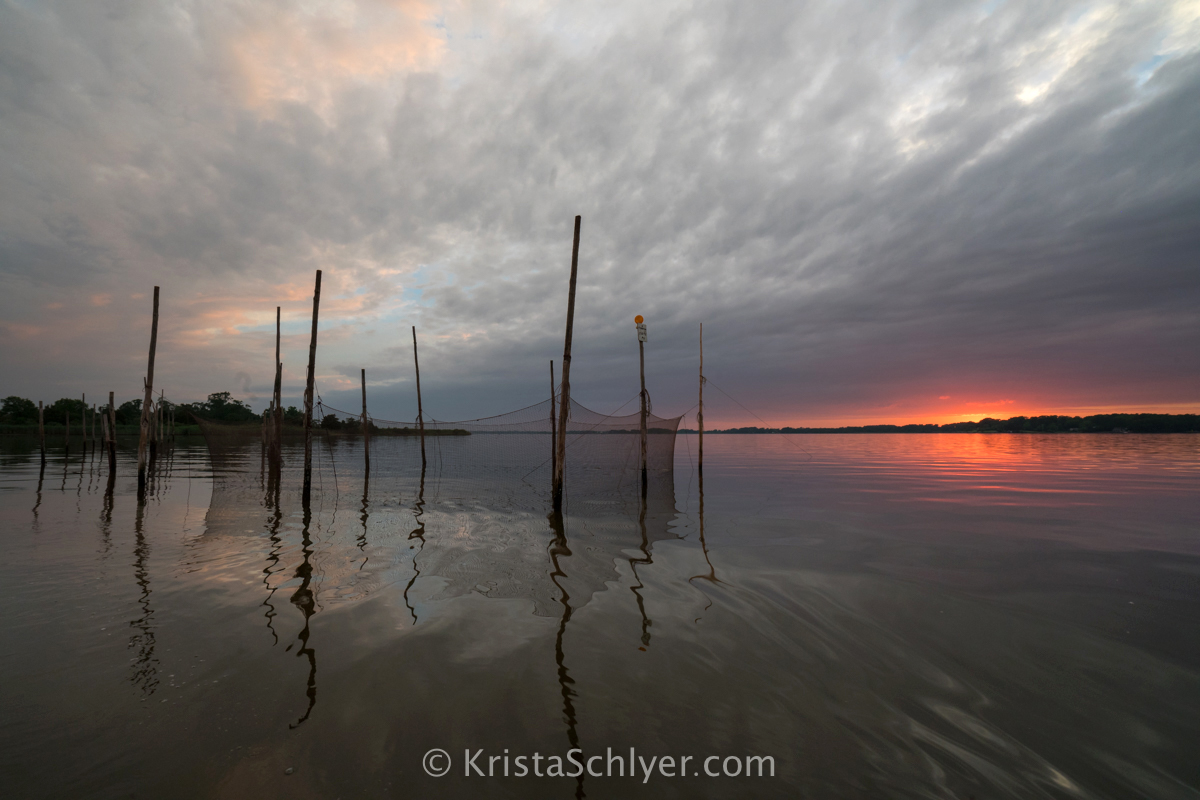
Fishing boat in the Chester River.

The reality is, for hundreds of years we have treated this precious estuary, the largest in North America, as a tool for transportation, commerce and human recreation. The Chesapeake’s intrinsic value and its essential value to thousands of other species has escaped us.

Maryland’s environmental department estimates that 20 percent of the land in Maryland can be classified as a Tier 2 Watershed. This is much more than I would have imagined. But one-quarter of that is in danger of development or other harm. And fully 80 percent does not qualify as healthy watershed. With the large majority of the state’s landmass considered to be unhealthy for its waters, we have a long way to go. Still, 50 years ago, a healthy bay wasn’t even much of a consideration. Today it is, and tomorrow it will be more so if history is any guide. There is reasonable hope that one day the heroic efforts of every riverkeeper, watershed organization, motivated public servant and responsible citizen, will lead us closer to the state of grace the Chesapeake existed in once upon a time.


The Eastern Neck, much of which is healthy forested land, is one of those rare places in Maryland that offer a vision of what was and could be again. On the passage to our anchorage we saw skates sailing through the water, blue crabs, schools of fish attended by hungry gulls and terns, and many jellyfish. ( Generally this last item is met with groans, as swimming with them is just slightly less desirable than splashing around in E. coli. But the light show off Eastern Neck has given us a new appreciation. ) And over the past month living on the Bay aboard Maggie May, we have encountered enough wild surprise to imagine how a resilient watershed could rebound if we humans could learn to love the land just a little more. 

As for Bill and I, we are currently in Rock Hall again, doing what I hope will be the last of the boat repairs for at least a little while. We are back at Haven Harbour Marina, which has truly been a haven for us through some emotional, financial and literal storms (this is where we weathered Tropical Storm Isiais.) Looks like we are back just in time. Hurricane Laura may be on its way to the Chesapeake.


Support this journey and blog

My plan was always to do a free blog to share the journeys of Maggie May and any cool, interesting and important things we might find along the way. Even with all the setbacks we've had, I want this to be a free blog. But if you are enjoying the story, and have some funds to support this journey and ongoing storytelling, the funds will help us continue on this path. Thanks!

$10.00

Confronting the Inner Squirrel with Farm Girl Grit

After Isaias

One of our first big weather events is behind us. Maggie May made it through Tropical Storm Isaias virtually unscathed.

We spent the day of the storm on high alert, as the wind forecasts were constantly changing. This uncertainty was the greater part of why we decided to go to a marina rather than ride the storm out in a hurricane hole in the Chester River. It was a good decision. I don’t think we were in the best mental state to weather near 50 knots at anchor. The past weeks since I last posted have been difficult– Coming to terms with the likely end of our long-planned circumnavigation, trying to adjust to a new outlook, and facing a near constant set of new challenges. 

The cumulative effect has been a gnawing, fraying self-doubt, an inner squirrel sitting prettily on a shredded confidence nest in each of our psyches. Open water is no place for such nagging uncertainty, a fact brought home to us every few days on the Maggie May. 

A few days before Isaias, we were sailing from Still Pond in the northern Chesapeake to Rock Hall, Maryland, where we planned to re-provision before heading back into the Chester River for a while. The storm predictions at that point were mild for the Chester, and there were several protected anchorages we wanted to explore.  We were sailing 15-20 knots, a good wind speed for Maggie May, but we were head to wind and the Bay was rough with unusually steep waves. We decided to forego the genoa (the large sail at the bow of the boat) and use our solent stay and a smaller sail we got for heavier weather. Bill was hanking on the sail, I was driving, and as he started to trim the sheet, CRACK!, the sheet snapped and started whipping around the deck, lashing hard against the dodger (the covering over the cockpit), out into the angry air beyond the boat, and back SLAM! onto the dodger, over and over…and over. The boat was being jerked by waves and tossed and pulled by wind. 

Bill said “We need to take the sail back down.” We didn’t have an extra sheet on hand to replace the broken one. Good to know. And the flailing spasms of the sail were dangerous. “Lower the halyard to me when I get to the bow.” 

Bill wrestled with the wild sail as the boat tossed about, I tried to keep us on the smoothest course, then put the helm on auto and went forward to help him stuff the sail down below. Once it was stowed, we rolled out the genoa and continued sailing through the rough bay waters. 

This is not an unusual intense moment on a sailboat. A year ago it could have happened and not rattled me much. I might have even found it exhilarating. But that day it stuck with me, along with the nausea and fatigue I always get from rough days on the water. Bill took the helm most of the day, and I tried to steady my wavering heart and belly. We arrived in Swan Creek near Rock Hall, anchored, and I retreated into my thoughts.

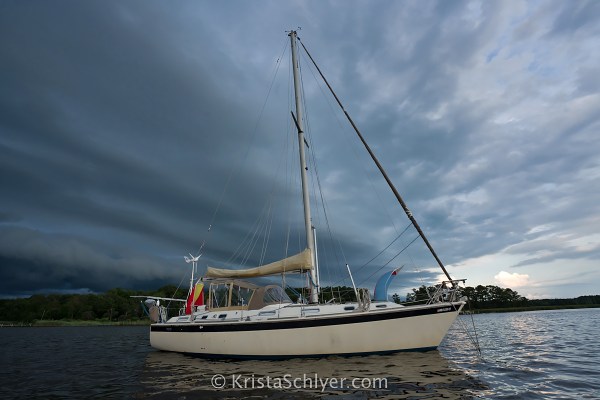
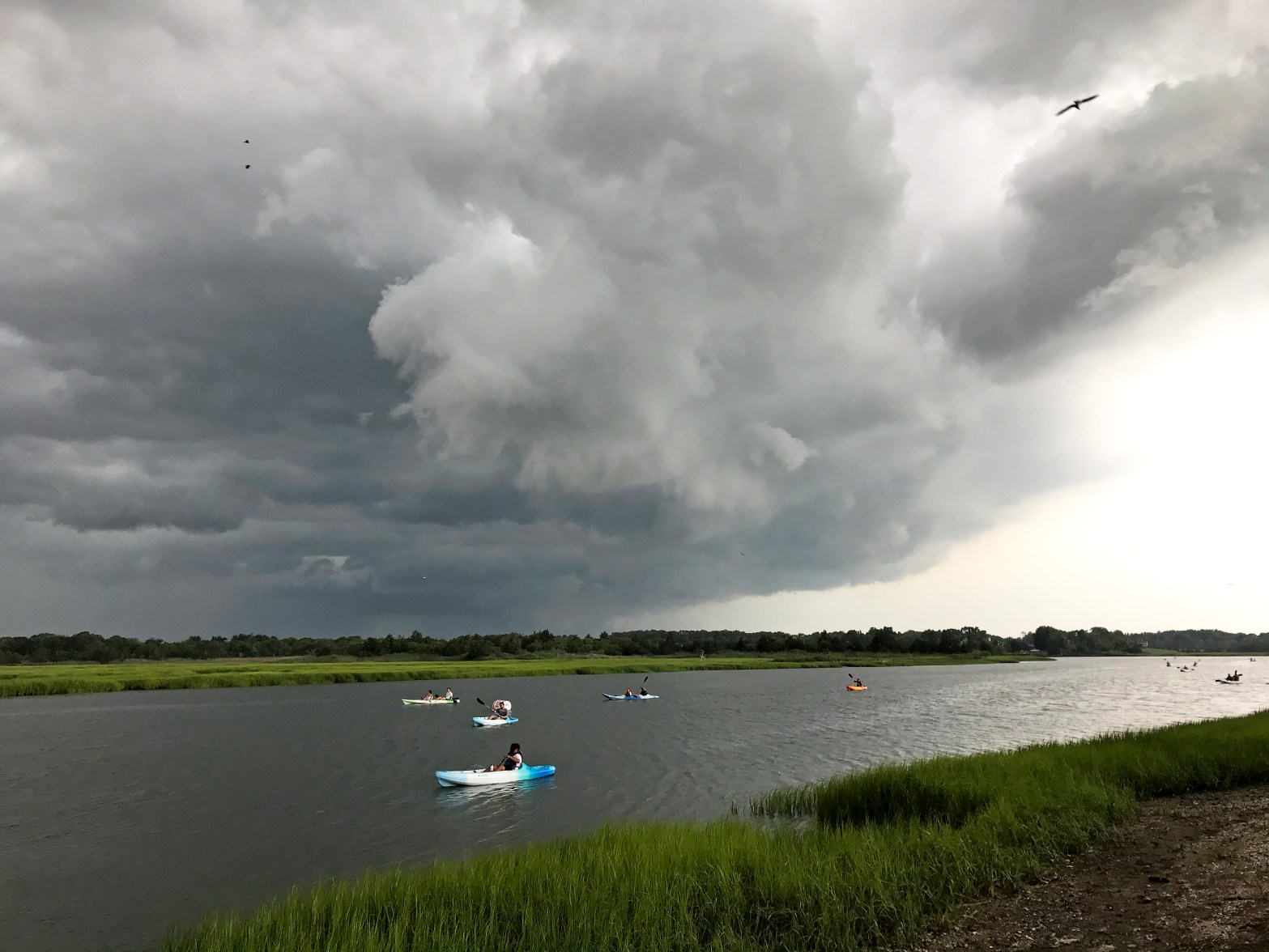
Thunderstorm approaching Cape May

So much has happened with Maggie May over the past 7 years, so much in the past year, in the few months since we moved aboard. I feel at this point as if I am always teetering off balance, waiting for the next thing to happen that will push me down again. Bill and I each have a constant inner monologue going, whatever we are doing, about what could possibly go wrong next. Though as the squirrel demonstrated, some challenges are just beyond the realm of imagination. 

I consider myself a pretty tough person, but I am confronted by fear in a way I never have been before, on a sailboat or otherwise. I’ve spent a lot of time recently telling myself, ‘You are not equal to this task. You’re not strong enough, mentally or physically. You’re too old. I’ll luck has beaten you.” But my heart holds fast to everything I had hoped for in this journey, and I think about all that has come before, so many challenges met and made into memory all the way back to ancestral memory from the early 1900s in rural Kansas.

First the recent past.

The morning after the squirrel chewed up our sail Bill woke with a fever and aches and pains. His doctor set him up with a test for Covid 19. My mind reeled over the absolute worst that could happen. He got the test the following morning. As we waited for the test results a new friend at the marina came over to say goodbye, expecting we were heading out, and I told him about Bill’s illness. He already knew about the squirrel, and barnacles, osmotic blisters, faulty bottom job and numerous other challenges we had faced over the past years. 

“Did you guys do a renaming ceremony for the boat?” he asked with some concern, the idea of very bad luck being written upon our lives. I told him we had done a nice blessing of the boat when we launched. His eyebrows knitted. Then he told me what he did when he renamed his boat, based on a lot of research into how you rename a boat. “I have a friend who renamed his boat without taking the proper steps and he has had all sorts of ill luck.” 

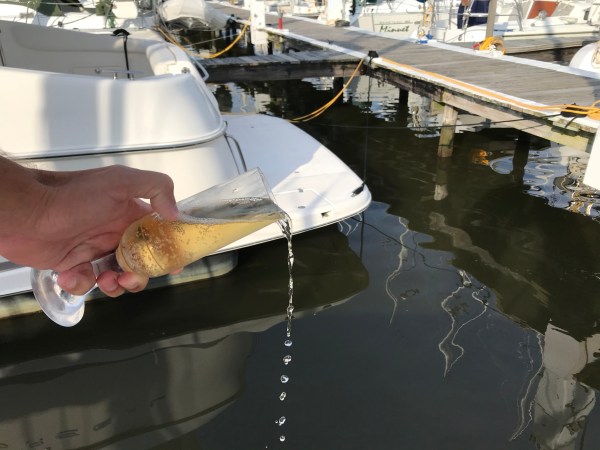
Libations for Poseidon

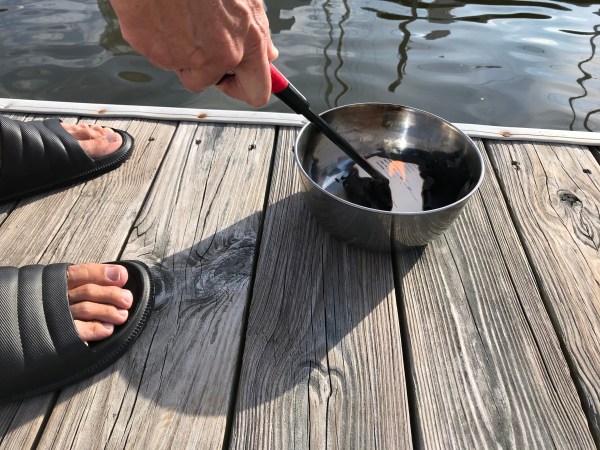
Burning all evidence of Kahouteck

I chuckled a bit, assuming he was at least partly joking, and thinking ‘Sailors, superstitious bunch.’ But after he left, I immediately went to look it up on the internet. I found one million entries about how exactly you rename a boat without incurring Poseidon’s wrath.

I started following the procedure to the letter. Renaming a boat requires taking all reference to the former boat name off the boat. I scoured every crevice and cranny aboard. Went through every binder and book. There were several Vilkas items, the wolf blanket and a key chain, and I even found one piece of paper that had the name of the boat two owners ago – Kahouteck (which sounds like an Aztec curse, but is actually the name of an astronomical phenomenon )This occupied me for hours, but Bill was in bed with a fever waiting for test results, so I had some time on my hands. 

The renaming ceremony requires writing the old name of the boat on a piece of metal with water soluble ink, which you will drop in the water. I didn’t have a metal name plate, so I wrote Vilkas on a potato chip in pencil, and Kahouteck on a Ritz cracker. I worried about not following proper procedure, but I figured if it was an item of great value it would work just as well, and dissolve all the faster. Poseidon would be pleased, and Vilkas and Kahouteck would give some “nourishment” to the fish.

You also have to take off any reference to the new name, prior to the ceremony. I gathered all this up, including Original Maggie May’s ashes, which sit in a central spot on the boat. We put all of this Maggie May gear on the dock. I covered the stern with a scarf, because Maggie May has her name there. Once all this was done, I waited til Bill was feeling a bit better and then roused him from his sick bed. We carried out the ritual, using the prescribed plea to Poseidon to vanquish the names of Vilkas and Kahouteck from his records, and to add Maggie May and watch over her.

I also said the proper prayer to the four winds and added in a plea to every sea god I could find in my book of world mythology. 

We made ourselves right with the gods. Bill went back to bed and I figured whatever happens next is well beyond our control.

The next morning Bill got a call that his test was negative for Covid. He was in bed for another day, but felt good enough to head out the following day. So it worked! Well, not if the past few weeks are any guide, during which we have run aground twice (once was our fault), gotten stung by jellyfish, had a staff infection, run over a crab trap which got stuck in our prop and damaged our rudder and cutlass bearing, and snapped a sheet. These things are all par for the course on a sailing adventure, but happening on the heels of everything else, they knocked us down to the ground every time. The crab trap in the prop happened near Cape May, where we were planning to jump off north toward Maine. In Cape May, getting the prop untangled and assessed, we decided that we needed to instead head back to the Chesapeake Bay, stay good and safe during the storm season, work on our sailing skills, (an unlucky sailor has to be extra prepared) and regain our trust in ourselves and the future of this journey.

A tropical storm followed us here, and regaining my confidence has been a daily affair. Recently, my mind has turned often to the boat’s namesake, once removed. Not Original Maggie May, but the woman Maggie was named after, my granny. Her name was Pauline Margaret, and she went by Pauline all her life, but told me one day a few years before she died that she always wanted to be called Maggie. My granny was a tough woman. She grew up on a farm in Kansas and lived through two world wars, Spanish Flu, the Great Depression and Dust Bowl. She kept that farm girl fortitude all her life. She was also terrified of water and storms and mayonnaise and untidiness. But she kept her chin up, always. Now, when my heart begins to cower, I think of her, ball up my fist like she taught me, and carry on. 

Note to friends:

I thank all of you for your care, kindness and support. We are ok. We’ve spent some hard days and done some reckoning and are at peace with looking at this journey in another way, waking each day and seeing what it brings, doing our best to live life ever present and appreciative. 

Upon much reflection I can see very clearly that the leap of faith we took 15 years ago and every day since, the intension that brought us to this place was not in vain. For the idea was never truly to make miles across the ocean, but to learn how to live again. To set ourselves in the crucible of nature and see what its foundational motion made of us. To let go of whatever the waves erode, whatever gravity wears down, whatever the salted water scrubs away. To hold on to what the winds bear up, and whatever remains at the end of this adventure. I still believe we will be the better for it.

And I wish each of you courage in the challenges that come your way, and a stout heart in these uncertain times.

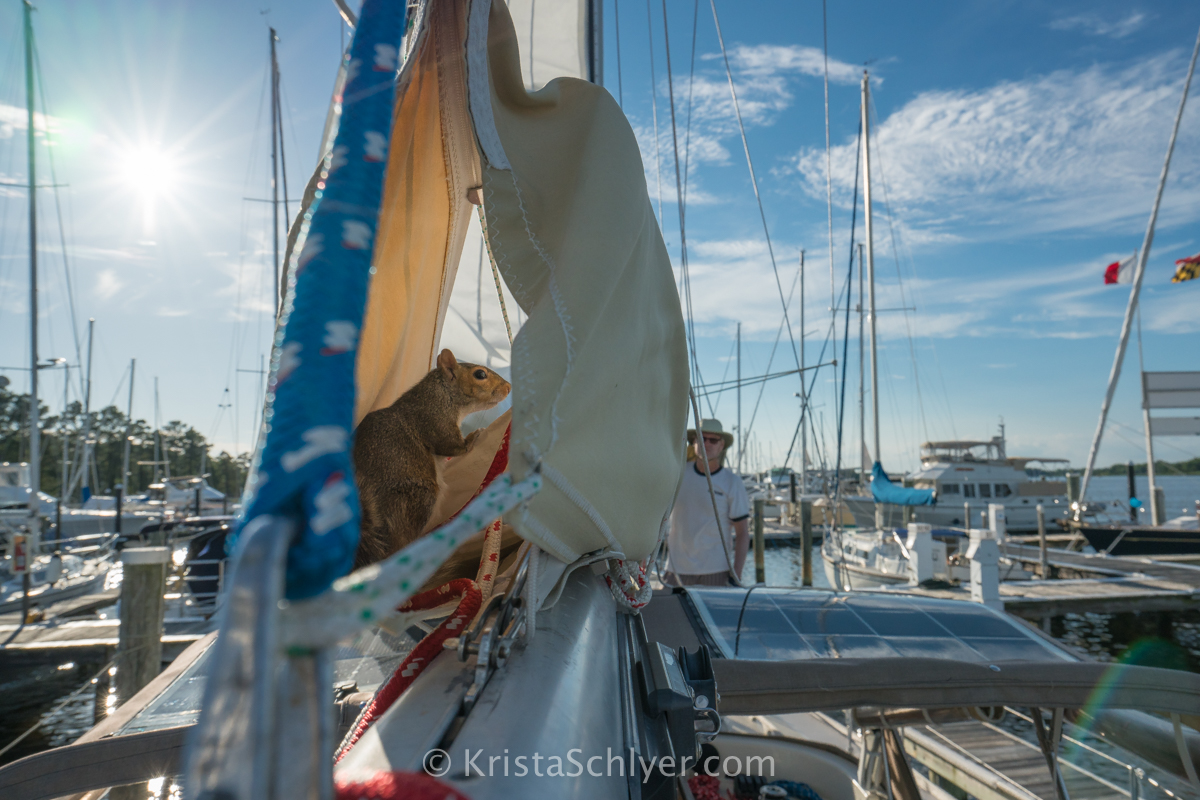
Fate Turns on a Squirrel’s Teeth

On the morning of July 9 my journal entry began, Setting off again this morning at high tide. We’ll see what transgresses. Headed to Maine.

It was to be our second attempt at a launch, but it followed the fifth or sixth major named storm in the life of our circumnavigation dreams. Still, we were both hopeful. We had no beautiful friends to wave goodbye to on the docks, and no champagne to sprinkle on the bow, but the day was calm as we pulled out of our slip and made our way to the mouth of Swan Creek and into the Chesapeake Bay. I’m not going to relay what happened next, it was the scariest moment I’ve ever had on a boat, but it’s a long, and in the end, humorous story that will wait for a book’s telling one day. This blog focuses on what happened afterward, which was not so humorous, despite the lead photo in this blog.

About an hour after we entered the bay, we still had no wind and were motoring along, which often makes me sleepy. So I laid my head down on Bill’s lap and looked up at the mast towering into the cloud-tufted blue sky. After a while, I asked Bill, “Can you still see the Bay Bridge?”. 

“Just barely,” he replied. 

So I sat up and scanned the horizon to the hazy south. I couldn’t see the bridge until Bill pointed. It was barely visible in the thick summer air, and I marked it in my mind, the Bay Bridge is behind us. 

Just then the wind started to pick up and Bill got excited to raise the main sail. We had only sailed once in the month since we left our home port in Deale. So I took over the wheel and Bill went forward to prep and raise the halyard. As the sail was going up, suddenly Bill stopped and his face fell. All he said was “No. No.”

I saw a cascade of white feathers, or something light like that, scatter onto the deck and float back along the starboard side of the boat. I thought a bird had nested in the sail, or been killed by a predator and left in the sail. But then I saw Bill sink to the deck on all fours, so I knew it was something much worse. I steadied the boat and went up to the mast. There was a gaping hole in the sail, which, as it gently flapped in the mild breeze rained a shower of feather-light dacron onto the deck. Two feet of sail had been chewed away. Our brand new sail. 

We had waited years to get that sail, wanting to spare ourselves the huge expense of it until we were ready to head out on the trip. It was ruined. It took a moment to make sense of it, but suddenly I remembered earlier that day I had seen squirrel footprints on our hatch and heard soft footfalls on the deck. Knowing how important a nest is to a creature, I went to scan the sail bag and sure enough, there was a terrified squirrel crouching at the back of the boom.

Bill and I were silent for a long time. Then a period ensued that I cannot recount here except to say that Bill turned the boat around, back toward the marina at Haven Harbour, and when I coaxed him into unfurling the only in-tact sail we had left, it was because I believed it would be the last sail we ever had and I wanted to remember it. 

Two days later, we ushered the squirrel from the boat and have had the sail repaired as best as it can be. It will never be fully strong again, but it may last a while. We have decided that we can no longer believe in the circumnavigation dream. We can’t even expect we will get to Maine at this point. Or out of the Chesapeake Bay. But we have provisions for several months on the boat, and many, many books we want to read and some songs we want to learn and sunsets to see and squirrels to forgive. 

We hope to head out again in a day or two with the only intention being to follow where the wind leads us, take what challenges arise, care for the boat as best we can, and love each other better than we ever have. 

Thank you all for following along on this journey, wherever it may lead.

Gratitude, Maryland

Where to start? Ohio, West Virginia, Pennsylvania, Maryland…all places I wasn’t expecting or hoping to to blog about at the end of June 2020, but that is the way of adventures.
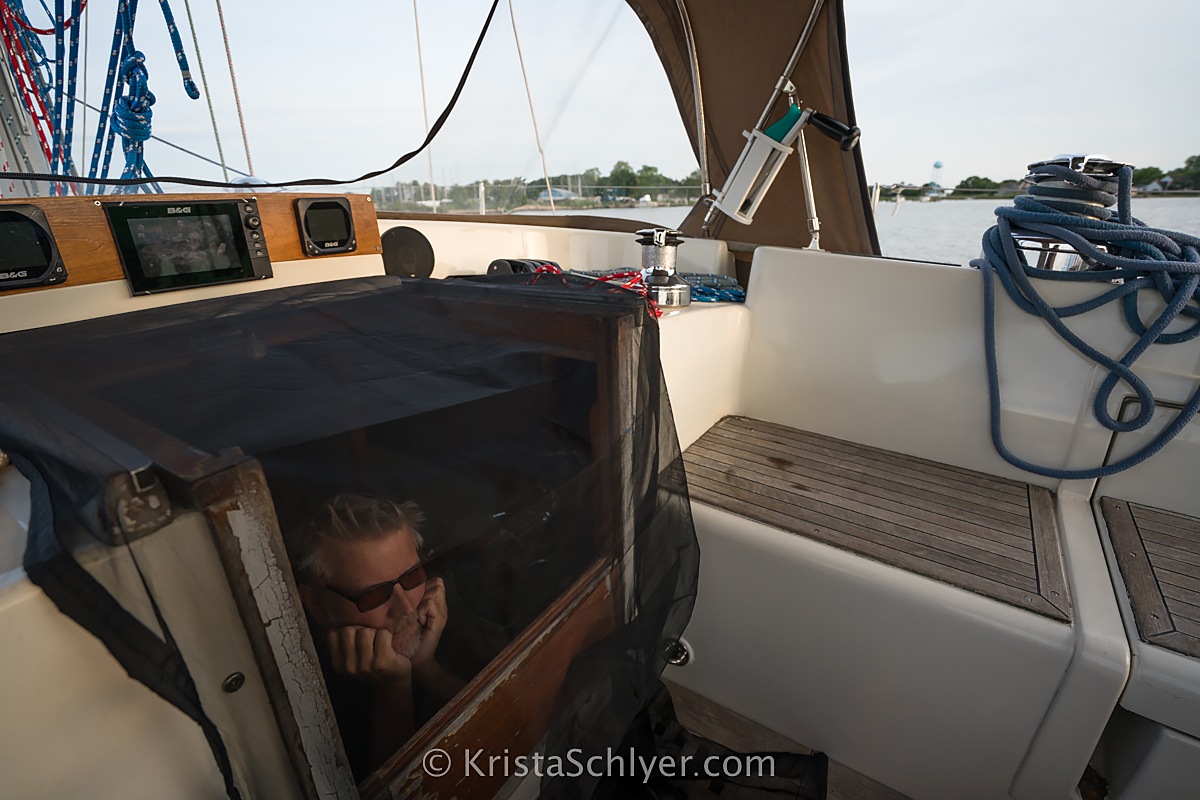
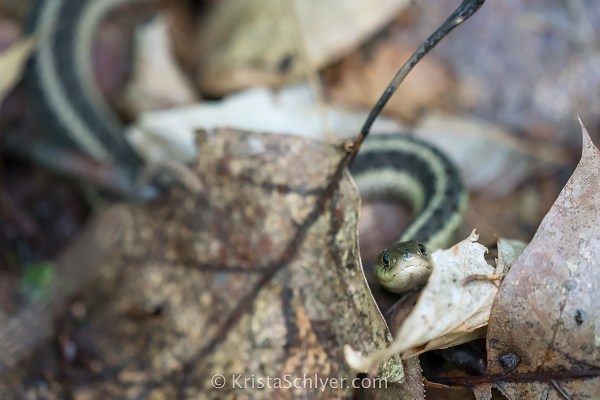
I’m writing from the dining room table of my good friends, the Goods, who have kindly and warmly welcomed Bill and I to stay with them while the Maggie May is, again, being repaired.

After seven years of fixing up an old boat you might expect there would be nothing left to fix, at least for a while. But sometimes you have to fix the thing that a contractor just did a terrible job fixing, so bad that it failed utterly within a few weeks. (This is not the first time this exact thing has happened with the Maggie May.) And sometimes that thing that was fixed and failed is the bottom of the boat, arguably the most important part if you fancy staying dry. 

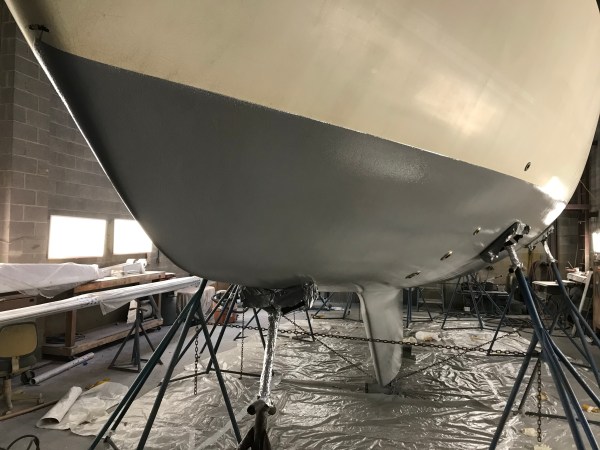
This is a long tale in full, and one that could benefit from a longer format and some emotional distance by the author, but in short, we had the boat hull completely redone over the past few months in Deale, Maryland, spent about three-quarters of a year’s boat-living budget, and within a week of setting out found that Maggie May’s bottom was covered with a half-inch or more of barnacles that could only be removed by power sanding the bottom of the boat and repainting.


This slideshow requires JavaScript.

This was the failure of the paint we chose, or possibly the marine contractor who applied it. Or both to some extent. Or us for choosing the wrong contractor and/or paint. So far neither business is taking responsibility. So we are left holding a heaping handful of slimy barnacles (no offense barnacles, you are actually slimy in the literal sense), and the loss of another half-year boat budget, several weeks of time, and our crushed hearts. 

The added loss of savings may ultimately have the effect of ending our dream of a sailing circumnavigation. That is a hard pill to swallow after dreaming and planning for 15 years. But it’s possible that the global pandemic already ended that dream and we just don’t know it yet. 

I didn’t want to write this blog, have been putting it off, hoping we’d be back on the boat already and I could write with optimistic hindsight, with the perspective of someone on the ocean, looking back. (With any luck that will be the next blog.) So much of what I have worked on over the past decade (see the Borderlands Project ) has been sad or at least tinged with grief in some way. I liked the feeling of offering only hope in this blog, a documentation of discovery and joy. But the world is filled with sorrows much deeper than the travails of Maggie May, and resilience and gratitude are good offerings too so I’ll finish on this note…

A day or two after we found out that the hull paint had totally failed, Bill was feeling especially low, and we were talking about our options, when suddenly a Carolina wren started singing. If you know this little bird, you know that it has incredible pipes, certainly some of the strongest per-ounce in the bird world. But this was the loudest I had ever heard a wren sing. It was not because this particular bird was  so especially loud, but because it was so extremely near. Bill looked up the companionway stairs and saw the wren perched on our main sheet. About 5 feet away, the bird was belting out the sweetest, most determined song. It brought tears to Bill’s eyes and prompted him to say, “Ok, I get it buddy, message delivered.” Then, about five minutes after that, Bill got a text from our friend Maribeth who was asking how his back was (she had read my previous blog). Bill explained what was happening with the boat and Maribeth replied with a Mary Oliver poem, Just As the Calendar Began to Say Summer, about going to nature to unlearn society’s obsession with success, machines, oil and money. 

The poem ends with these lines: 

By fall I had healed somewhat, but was summoned back to the chalky rooms and the desks, to sit and remember

the way the river kept rolling its pebbles,

the way the wild wrens sang though they hadn’t a penny

in the bank,

the way the flowers were dressed in nothing but light.


Youghiogheny River in Western Pennsylvania, rolling its way to the Mississippi River and onto the Gulf of Mexico. We hope to meet these waters again one day far downstream in the SV Maggie May.

It’s impossible to say what will happen with this adventure. We hope to be back on the boat by next week and will proceed with a new dream of taking the journey as it comes, resting tired spirits and cherishing each moment for what it brings. It is a helpful reminder that the boatyard where Maggie May currently resides is just down the road from Gratitude, Maryland.

Garter snake in Ohiopyle State Park, PA

So far the past week’s detour has brought many things, including:

  • Moments on the Youghiogheny, Potomac and beloved Anacostia rivers, watching them rolling their pebbles, smoothing all hard edges as they make their water-way to the sea
  • A chance to hand off our car to Bill’s mom via his sister Laurie and her beau Bill on a country road in Ohio (Thanks Laurie and Bill!) 
  • Bill’s back fully healed!
  • A visit to the Double R creamery nearish to Cleveland for perhaps the best chocolate chip cookie dough ice cream I have ever had
  • A discovery of some weird larvae living inside a pitcher plant in an Ohio bog
  • A flock of cedar waxwings in a serviceberry tree
  • A visit to the largest remaining expanse of old growth hemlock in Maryland

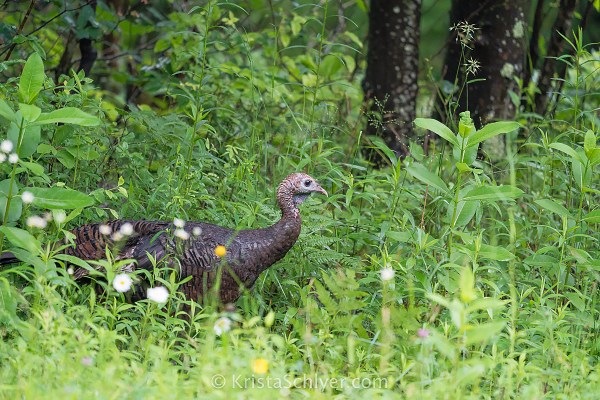
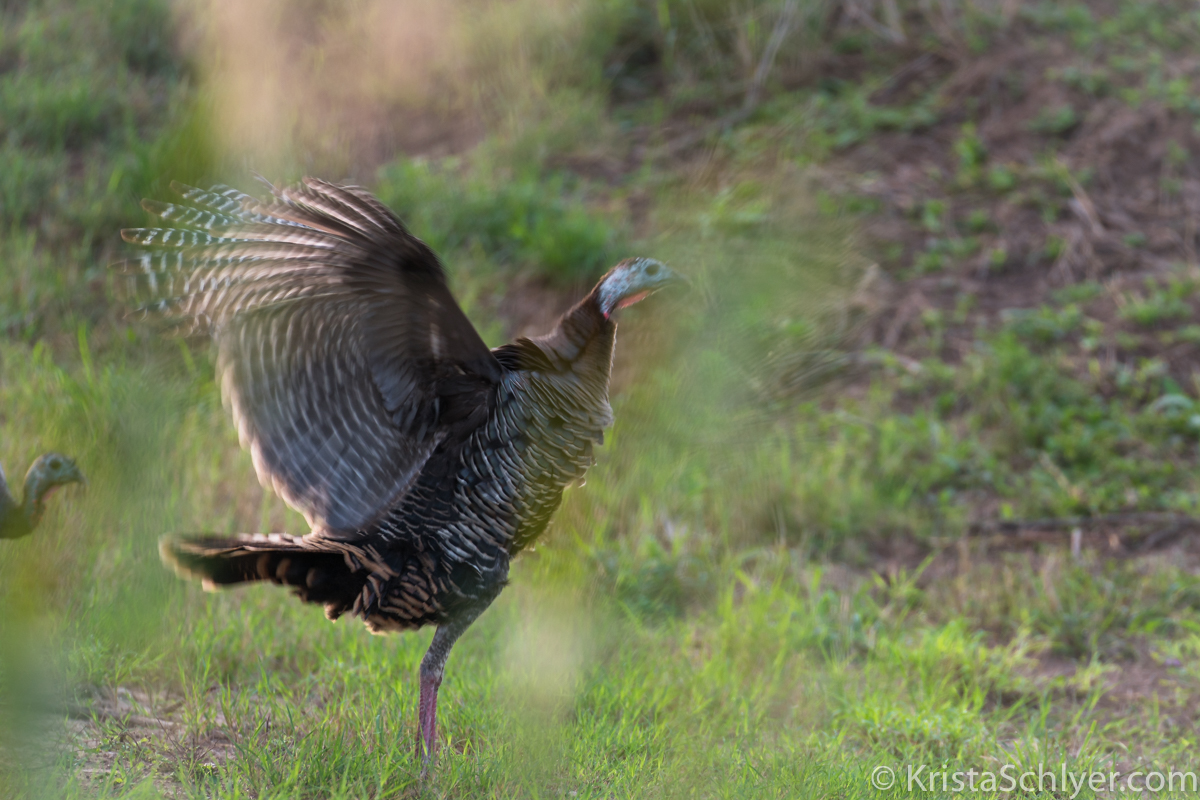
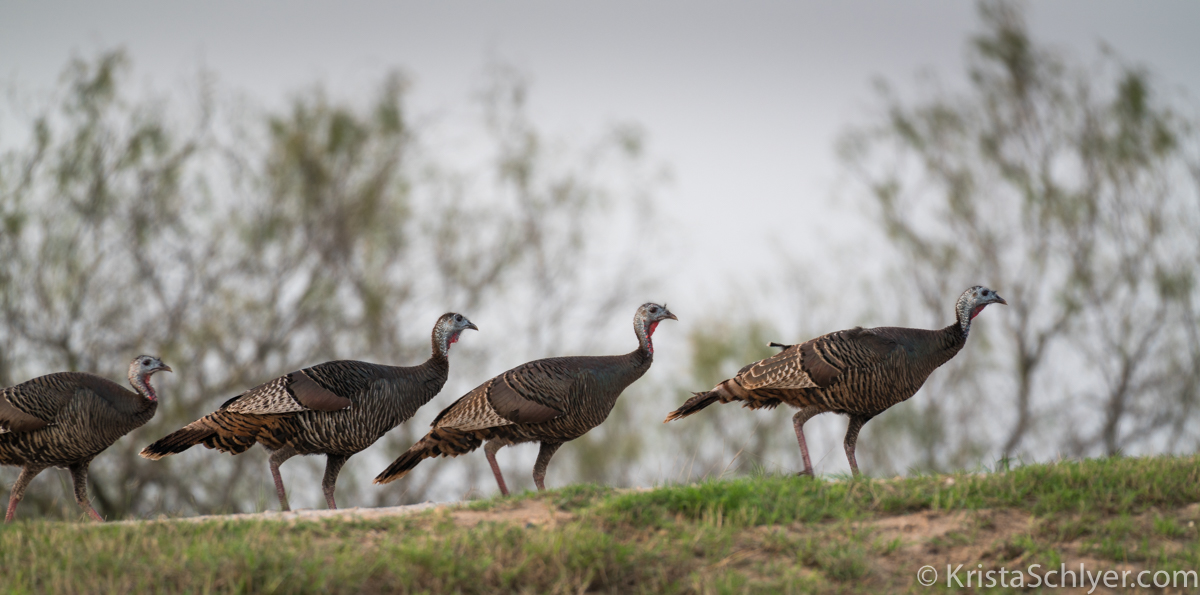
    Wild turkey in Garrett State Forest, PA
  • An opportunity to grill asparagus 20-feet in the air overlooking the Haven Harbour gravel boatyard
  • The best cherry pie I’ve ever had, made by the clever hands of Michele Good
  • A chance to spend some time getting to know the nearly 1 year old Henry Good–oh boy what a charmer. 


The Voyage Has Begun

Chesapeake Bay: Rockhold Creek to Chester River

6-14-2020

Last Tuesday, June 8, 2020 we cast off lines at Town Point Marina in Deale, Maryland, and headed out into the Chesapeake Bay for what we hope is a 3-year voyage around the world. Dear friends began arriving around 8 am and we said a few words, read a poem of blessing, and sprinkled some champaign on Maggie May’s bow. The surge of emotion that accompanied all of this, caught me off guard. There are just some times in life when you have worked so hard on something, given everything you possibly have to make a dream become a reality (or stave off some catastrophe), when past, present and future well up together for a moment. All this to say, I barely got my words out, they were choked and garbled with raw relief, joy, apprehension and possibility. I think my friends understood. Here is the poem in full:

(c)Krista_Schlyer_-04872
blessing the boats
by Lucille Clifton

may the tide

that is entering even now

the lip of our understanding

carry you out

beyond the face of fear

may you kiss

the wind then turn from it

certain that it will 

love your back may you

open your eyes to water

water waving forever

and may you in your innocence

sail through this to that

Several friends sent this poem to me over the past few months, knowing our departure was imminent. It is so perfect in so many ways. 

(c)Krista_Schlyer_-05380

I looked back for a long time at my friends Margaret, Valerie, Dave and Anne waving goodbye from the dock where we spent so much time preparing Maggie May, and at our friends Tom and Emily who had brought their canoe to see us beyond the jetty. I looked back as long as I could, to remember that moment forever, to feel that love and the waves of gratitude for the life we have lived up to now. When I turned finally towards the bay, I turned to the great unknown I have longed for for all these many years, through so much grief, anxiety and inner turmoil. I turned toward fear and wonder and adventure and a life scoured to its barest elements.

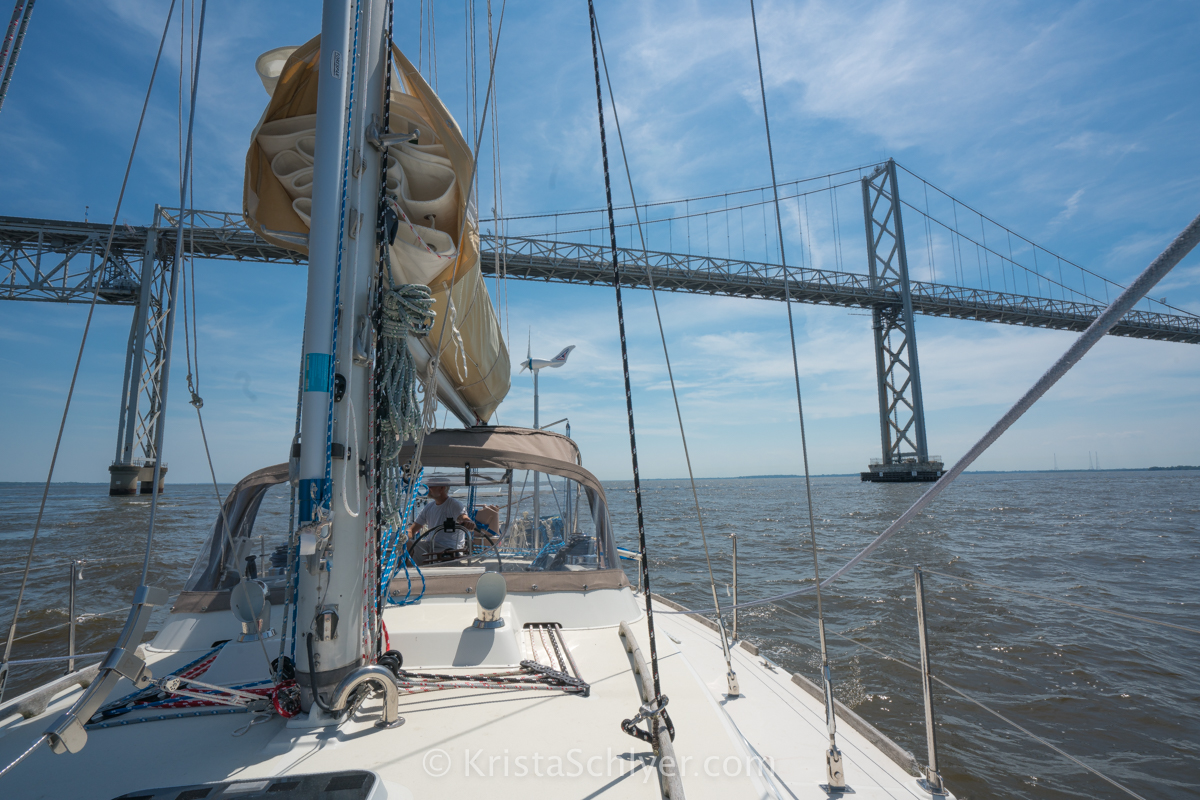
The first leg of this voyage will be northerly so we headed the boat up the Bay towards the Chesapeake Bay Bridge. The wind was light, 5-7 knots, but we managed to sail most of the way up to the bridge. I’d never passed under this immense span before. I’m not one to find awe in infrastructure, given all the damage it does ecologically, but passing under the Bay Bridge was something to remember, in part because of its mammoth imposition on the entire viewscape, and also because it was further than I had ever taken Maggie May to the north.

(c)Krista_Schlyer_-05495

Beyond the bridge we made straight for the Chester River, where we planned to anchor for the night. This river, the longest navigable waterway on the eastern side of the Chesapeake Bay, is home to the Eastern Neck National Wildlife Refuge, where we hoped to spend most of our time for the next days. But the wind was not favorable for an anchorage near the refuge, and the wind decides and we abide, so we headed deeper into the river to a little cove near the Comegys Bight. It was a good thing we did, because the weather grew nasty over the next few days. 

(c)Krista_Schlyer_-05536

Before the storm we had a few trips out in the dinghy to explore the nearby wetlands, beach and forest, finding many surprises, including the largest concentration of brown water snakes I have ever seen. Bill, terrified of snakes, vowed he would never set foot in this water after we made this discovery. We poled the dinghy into a shallow stream through thick wetlands and on the way out I noticed a little snake face staring out at us from the reeds. And then another and another and then, when we reached the mouth of the stream, a snake swam in right front of the dinghy with a fat, pale yellow fish with bewildered eyes, clamped in the snakes satisfied but anxious maw. The fish was easily three times the size of the snake’s head. I didn’t know they hunted for fish, and it was incredible to see this in action. 

Bill did not experience the same delight over this discovery as I did. 

As we got back to the Maggie May Bill was trying to secure the dinghy (Minnie May) and he wrenched his back painfully. His back had been bothering him for weeks, but I think the terror over the snakes and the jolting movement of the boat pushed him over an edge. And he probably had not been allowing his body to rest over the past weeks leading up to launch. Now his back has said, you will stay put for a while. So we have stayed anchored in this same Chester River spot for many days longer than we would have. Storms rolled over us and rolled on. Weekend boaters tubed in circles around us, their wakes tossing Maggie May about. Sun set and rose, casting its light and darkness upon the world. (c)Krista_Schlyer_-05688

I am content, wherever we are. I’ve spent the past 5 days learning how to live this life. I have learned many things, some important and some not so much. Here are 5:

  • Clothes are a nuisance, I shan’t be deploying them very often.
  • Peeing over the side of the boat (with the assistance of a she-wee, a tinkle-belle or other device) is liberating. Women of the wild, you must get one of these if you have not already.
  • Flies are obnoxious on land, intolerable on a boat.
  • Beer tastes delicious on land, on a boat the trumpets sound and the angels sing.
  • Being able to produce all of one’s own energy without dirty fossil fuels or industrial scale renewable energy is one of the best feelings I’ve ever had. (I’ll do a blog on our systems one of these days.) We have met or exceeded our energy needs for the past 5 days with our solar panels and wind generator. 


Setting Sail

84589775_10156889739728779_933850976777928704_o
Our planned route. Just run that US East Coast line a little further north, and hopefully it won’t change much. PHOTO: Margaret Boozer-Strother

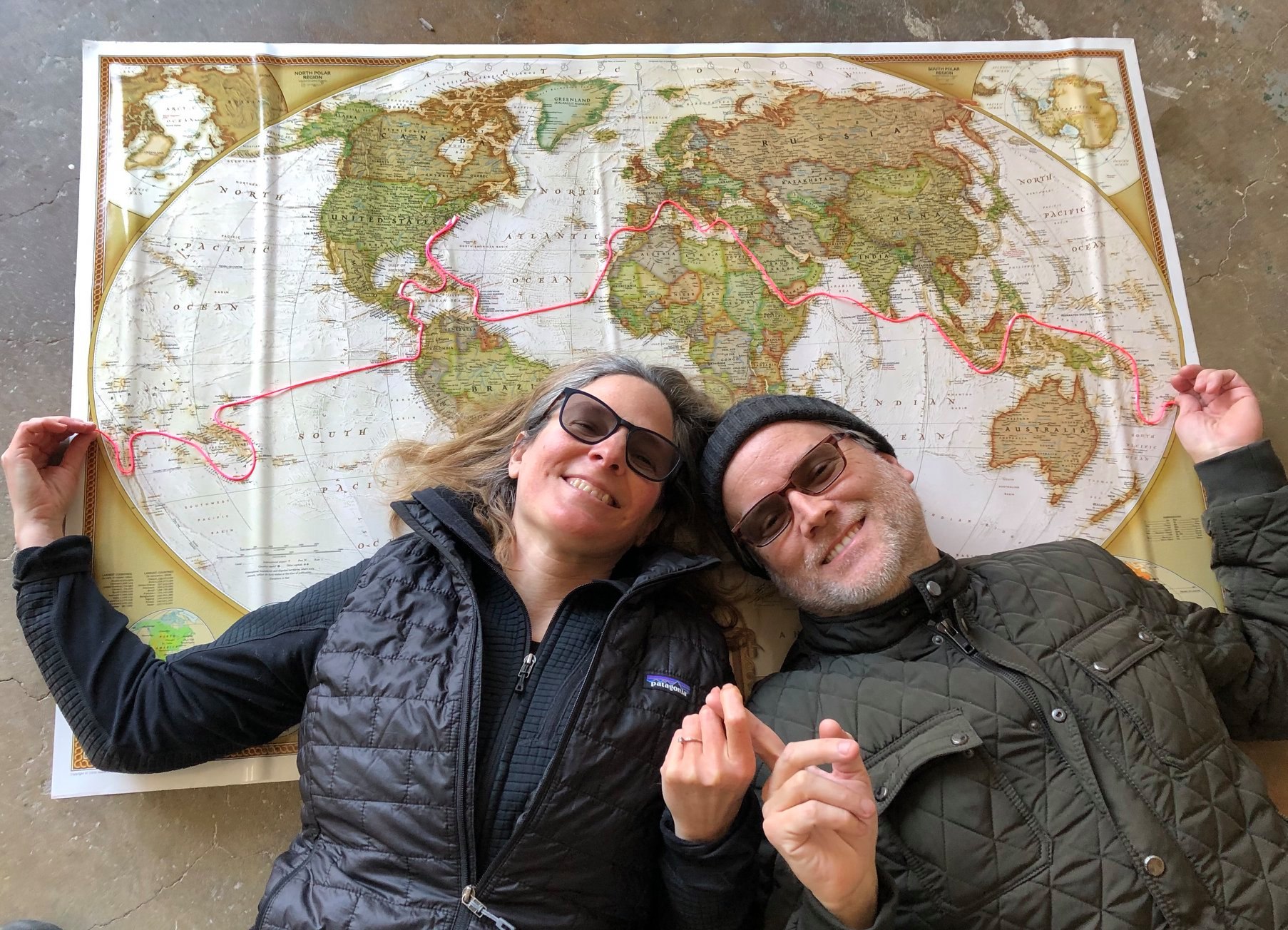
Launch is imminent. Destination flexible.

So much has changed from when we first started planning this voyage 15 years ago,  even in the past few months, right down to the direction we will be going. Our hope had been to travel southward along the Intercoastal Waterway to South Carolina, then head out into the Atlantic to the Bahamas, then following a westerly route through the Panama Canal and around the world back home again. That may still happen but Covid-19 has shut down most of the countries we were planning on visiting, including our first stop outside the United States. A few countries are opening, but tentatively, and it is very uncertain how their residents feel about sailors coming to their lands from far away, especially Covid hotspots like the United States. This may change in time, but hurricane season is looming—three named storms already, which means it is likely to be a bumpy summer in the hurricane belt.

This voyage has always been about finding some peace and beauty and getting to know the world in a deeper way. Foisting ourselves upon wary islanders during intense weather seasons just doesn’t fit that goal. So we are heading….north! We’ll stay in the United States for the hurricane season and reassess in November. For now, starting at any moment when all of our final projects come together and we have all provisioning and life-ordering finished, we aim toward Maine. We’ll stop at National Wildlife Refuges, National Seashores and other natural places along the way, taking our time, listening to the sounds of the water and the life that is ever drawn to it. 

As promised in my last blog, here is a tour of the SV Maggie May.

And here’s a special musical treat from our friends Blue Plains, apropos for this moment. They played this song at our going away party in February, just weeks before the world shut down. So glad we got to see so many shining, beautiful faces that day. We carry you with us.

If you’d like to follow Maggie May as she travels, follow this blog and check out our Maggie May tracking map.

At Home With the Gods of the Chesapeake

We made it. After 15 years of planning, 7 years of working on the boat, 2 months of pandemic lockdown, we are finally moving aboard Maggie May. Bill and I have spent the past few days carting carloads of stuff from our home basement and our friend Dave’s home, (where we were staying for the past few months), to the boat in Deale, Maryland. 

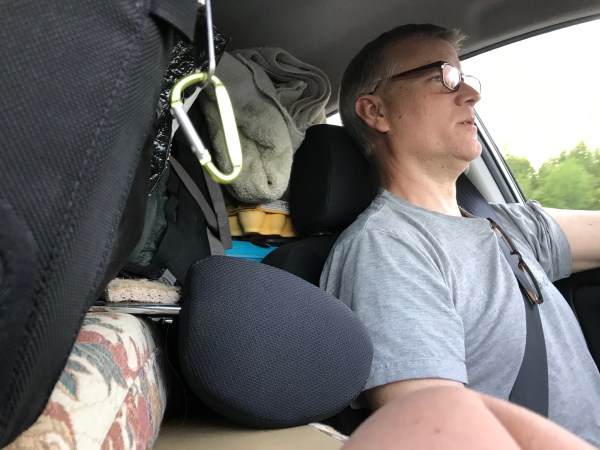
Bill and I have a bet as to how many carloads it will take to get it all here, and also whether there is any chance it will all fit aboard. I guessed 10 trips, Bill guessed 6. We are on 6 now, with at least 1 more to go. This is one bet I was hoping Bill would win. 

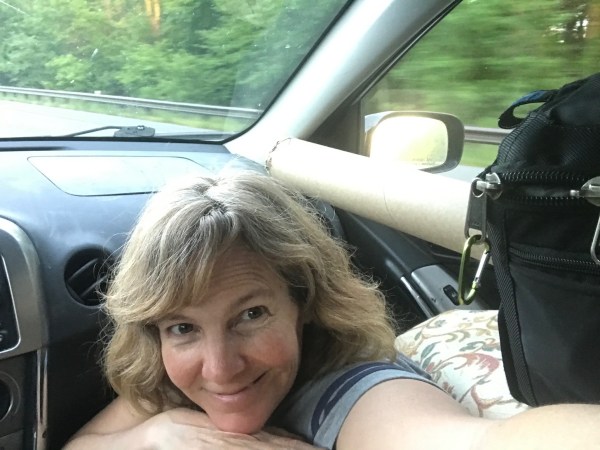
Our final trip from Dave’s house. Bill said we couldn’t get it all in one load. I begged to differ. As my reward I got to spend 45 minutes on the passenger side floor fighting off car sickness. Hooray.


Glad we were able to fit that sponge.

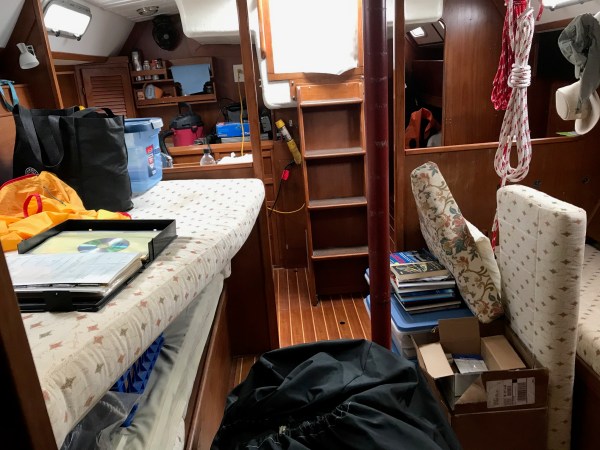
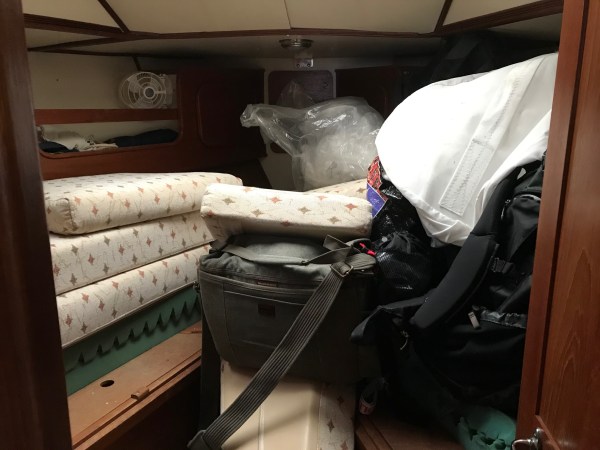
So far everything is fitting nicely on the boat, but we are already making some sacrifices, books, clothes (we won’t need those), backpacks, some tools and other things we can do without.

The process of trying to organize a small amount of space to contain enough food, water, clothes, gear, cleaning supplies, tools, sails, spare boat parts, medical supplies, charts and everything else we need for 3 years uses a part of my brain that I rarely access. But I find it liberating rather than constraining to think about what I actually need to be safe and happy. It’s not much really. 

The stuff we have on this boat represents about 10% of the stuff we had in our 700 square foot house. But it still seems like a lot right now.

The V Berth will be my office as well as guest quarters, sail storage, and scuba center.

One of the inspirations for this trip was to put myself in a situation where by necessity I had to live as simply as possible. I try to do this anyway, but it’s easy to be lazy about resource conservation when all the energy, water, space, and food you could want is a drive, walk or phone call away. And all of the waste from that way of living is carted away every week so I don’t have to look at it. On the boat, there is limited energy, water, space, food and everything that is a byproduct of my life—plastic, paper, metal, food scraps, human waste. Well now it’s all mine to deal with in a responsible way. I’ve spent a lot of time over the past few years thinking about how to do this. I’ll share some of this over the coming years. 

Dinner our first night aboard.

Yesterday the wind blew across Rockhold Creek with gale force. I’ve experienced gale force winds before, even on the boat while sailing. But never while living on a boat and it struck me yesterday as the angry wind howled around the mast, that this force will be ruling my life over the next few years. The wind is nothing to be trifled with. 

We live our lives generally with the wind as an afterthought. If it’s windy we may fly a kite, or maybe some of us get our energy now from wind power, or maybe it musses our hair, or cools us down on a hot summer day. But it doesn’t really play much of a conscious role in our lives. Yet, the wind is a god of this planet—a conductor of weather, a circulator of energy and moisture around Earth, a force as big as the oceans in the life that is lived all over the globe. I’m going to spend the coming years honoring this god like I never have before. My heart skips a beat at the thought of being enveloped in its power and spending every day thinking about what the wind is planning for the world at this moment, and how to I need to behave to live in concert with its whims, and what exactly will happen if I don’t. I’m already awestruck and no small amount scared. But also thrilled to my marrow. 

Another impetus for this journey was exactly this. To immerse myself in the natural world. Our species, (I can say our, because if you’re reading this, you probably are a member of that party) lost our humility in the face of nature ages ago, back when we decided to throw over the nature gods of early myth in exchange for ones that looked like us. And we have grown more and more estranged as industry and technology have further elevated our perception of ourselves. I have swallowed a sickening sense of this year after year as I watch more and more of the natural world succumb to our hubris and excess. It has been a poisoning of the soul to see this everywhere I look. And this journey is designed to extract that poison, even if it means cutting some deep wounds to get to that toxin. For me this means humbling myself to the elements, wind, water, sun, earth.

The first night on the boat after we moved in I couldn’t sleep. Excitement, anticipation, wonder over reaching this state of living after so much time and effort. I lay awake in the stern cabin, with less than an inch of fiberglass between me and the Chesapeake, listening to the gentle water slap against the boat. Living in the waters of Earth, this is what I have needed.

I am awash in gratitude, relief and contentment.

Coming up in my next blog, a tour of the Maggie May.

SV MMMotivations

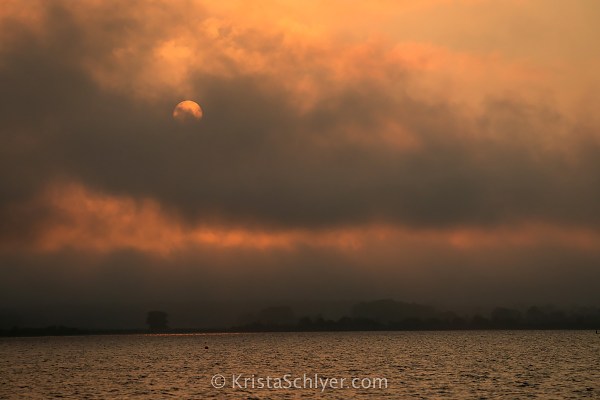
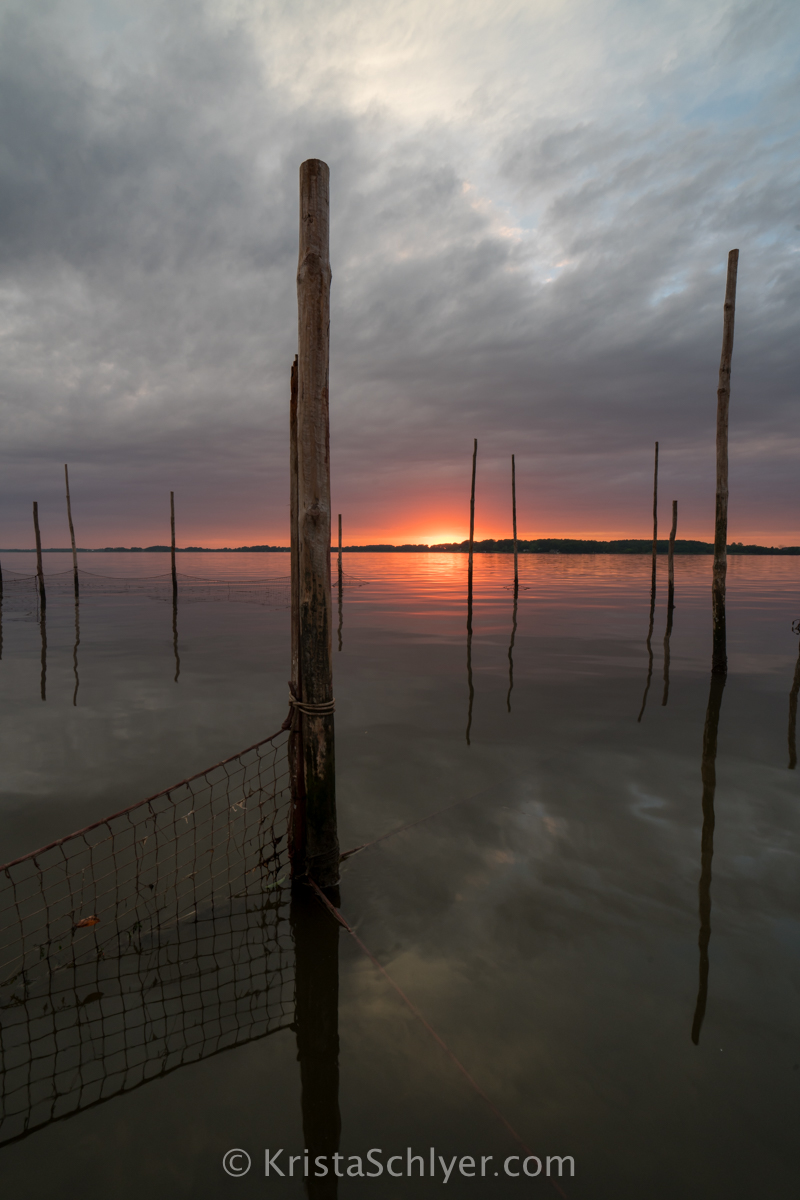
Sunset on the Chesapeake Bay, Maryland, USA.

The virus has offered lots of unbidden time for reflection. Time is a coin I was yearning for, if not in this manner and upon dry land. But it is valuable and I spend a lot of it thinking about what has moved me toward SV Maggie May over a 15-year period.

Bill and I hatched the circumnavigation idea after our last big journey, a year-long road trip around the United States in 2001. We both felt that the time spent away from human-structure was important, fundamental even to our long-term health. And so we had a conversation about what our next adventure would be and when. Within minutes we had settled upon sailing the world within 5 years time. Sailing has stayed constant, the time element elongated considerably.

I wasn’t a sailor when we started thinking about this but I had always had sailing around the world somewhere in my mind. (I’ll have to try and unearth a first-cause back in my brain folds.) I was drawn to some intangible something of sailing life. I now have a more specific sense of what that something is, a sense that has become stronger over the years as the 5-year-plan stretched into 10 and 15.

Sailing, unlike anything I’ve ever experienced, has a way of making you feel small and insignificant, but also powerful and eternal at the same time.

I’ve spent most of the past decade working on a project in the US-Mexico borderlands, witnessing destruction of land, decimation of wildlife and plants, desecration of culture, all of which made me feel small and powerless for years on end. This project prevented me from making faster progress toward SV Maggie May, and it also made her transform from an idea, then a desire and finally into a necessity. The borderlands kept me from the ocean, even as they pushed me toward it.

Desert cottontail near border wall, San Pedro National Riparian Corridor, Arizona.

I’ve worked on other projects, including extensive work on one of America’s most degraded rivers, trying to give voice to urban wildlife, documenting the British Petroleum oil spill. But none has been a driving motivation in my life for as long as the borderlands, and none has caused so much self doubt and undoing as fighting the border wall.

My motivations at the border grew out of a desire to make my life mean something. Not…just a desire, a compulsion, born of the greatest disappointment of my life in March 2000. I’ve written a whole book about those events, so I won’t go into it in this blog. But in essence I lost a good part of myself and afterward set out on a path to find what I had lost and find some grip on life again. I found a focal point in conservation photography, and a specific anchor on the US-Mexico border. I’ve also written about the borderlands extensively, so I won’t cover it here, except to say that by spending time with the wildlife of that landscape I felt I had made a compact with them, that I would do everything I could to be a voice for their future.

I stayed true to that commitment for more than 10 years, and over that time I went from feeling I was certain to be able to help turn things around, to feeling I had no power to even help, to feeling I could make a difference over a longer period, to feeling I had made no difference at all despite trying everything I could think of. And now, just feeling tired and destroyed, laying on a battlefield, eviscerated but somehow still living.

I’ve tried so many times to come to terms with the fact that I am small, just a person. And the forces that compel people to build walls are far beyond my scope to heal. And that the best I can hope for in any such endeavor is to open a window in people’s minds to see what they otherwise could not, something beautiful that might instill some responsibility for lives they will never encounter, but nevertheless impact gravely through direct action or passive complacency.

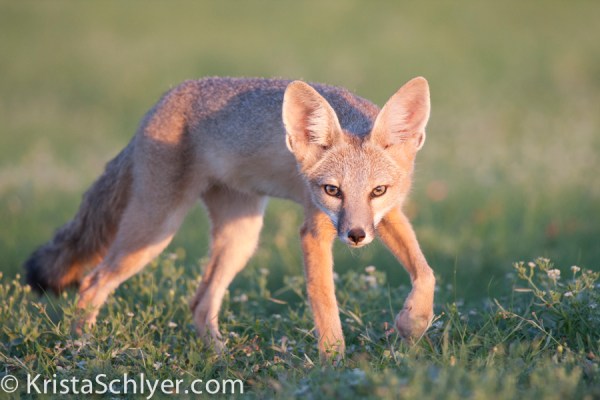
Kit fox in the Janos Grasslands, Chihuahua.

This is wisdom, but it requires a balance that I have always struggled to maintain. Instead I have often found myself on a roller coaster of belief in myself and my ability to make a difference, and despair over my insignificance. Teeter-totter-teeter-totter. And inevitably when outcomes are not what I have worked for, I am overwhelmed with guilt, and more acutely, grief, over what we are doing on the border, and so many other places.

My only true relief from this rollercoaster is on the Maggie May, where these two opposing forces merge peacefully. I am nothing, I am everything. Minuscule, microscopic, but connected to the very forces that make this world and everything in it. Wind, sun, water.

Mostly, I’m just alive.

***

Bill just came to tell me our Maggie May contractors called.  The last of our major boat projects is finished.

I’m coming home Maggie May.


COVID Dreams

It’s a COVID miracle. Maggie May’s bottom is finished.


In some universe, the Sailing Vessel Maggie May was launched by now. Not here.

On February 8, our friends and neighbors gathered  at Red Dirt Studios in Mount Rainier, Maryland, to bid us farewell. I’ve never been married, but I imagine this is what one’s wedding would feel like, an overwhelming feeling of love at a moment of great transition. Friends from our 20 years in the Washington DC area, many we hadn’t seen in more than a decade, and some family making surprise journeys from far away places, came together for chili, home-brew and music and to wish us well on this journey.

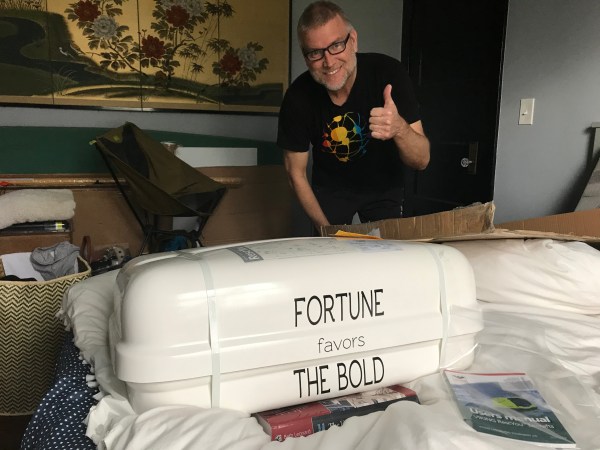
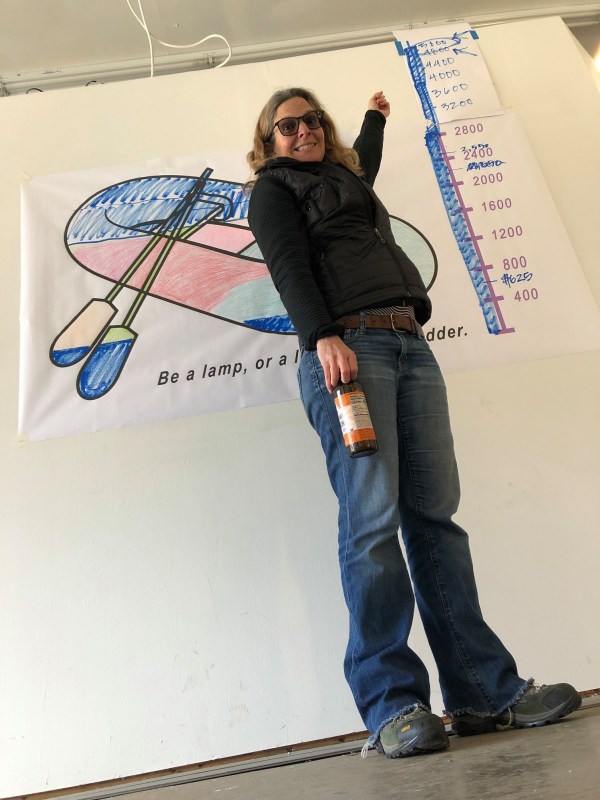
Our dear friends in the arts community of Mount Rainier also organized a fundraiser around the party event, gathering enough money to buy us a life raft–in hopes we come back safe even if the Maggie May does not. Thank you friends, we’ll carry your love and goodwill around the world with us…if by great fortune we set foot on a boat, in the water, ever.

Captain Bill with our new life raft. Our friends and family donated the funds to buy this important piece of survival equipment. One of our good friends named the raft.

A few weeks after the party, we moved out of our house, which we have rented for the next two years to a delightful young couple Cassandra and Mark and their dog Colby. We moved in with our friends Dave and Kendra on March 1. The plan was to be here for a few weeks until the boat was finished.

Photo by: Margaret Boozer-Strother

Enter COVID.

It was about a week after we moved that the coronavirus started gaining attention in the media. About a week after that its official name was changed to COVID-19 and Maryland was on lockdown. Dave and Kendra had to start working from home. Bill and I could no longer go work on the boat. Shipments of important boat components languished in warehouses. And our contractors efforts slowed to a painful crawl…along with everything else. The boat project, which was supposed to take 2 months, is going on 5.

Our window to escape the hurricane belt before the storm season begins is winnowing. Our years of planning and organizing our lives around this idea, locked in limbo.

A part of my mind says well boohoo, you can’t get on your sailboat and travel the world chasing a dream. Krista, your problems are ridiculous in the scope of what’s happening right now. The truth of this is indisputable. Yet here I am, feeling trapped and helpless.

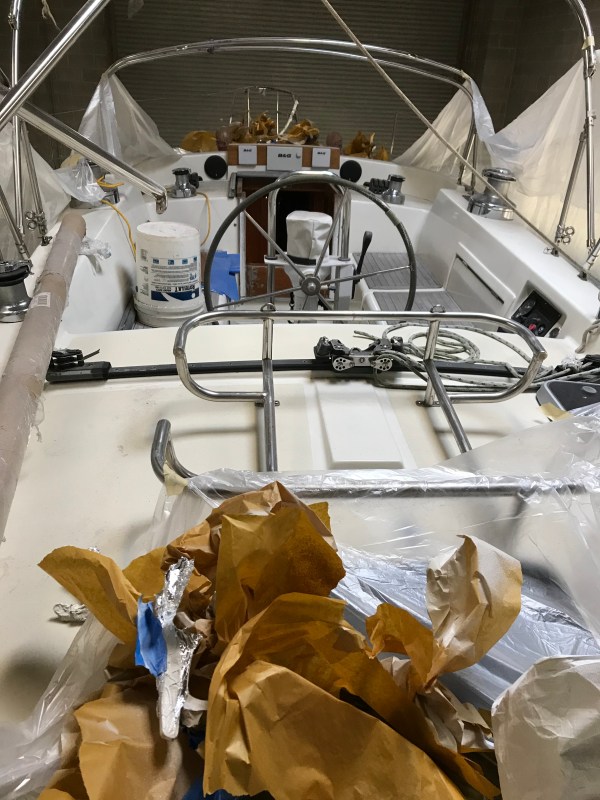
The deck is still in disarray, but this is the last major project before Maggie May can be launched.

I’ve spent a lot of time trying to practice patience, fighting with despair, feeling guilty about my discontent. I should be grateful at this time of unimagined uncertainty and grief, grateful that I am healthy, have shelter and food, a healthy family and friends and all of the things that so many of us either lack or take for granted. Plain and simple I should feel grateful. But should doesn’t always work in a stubborn mind. And so I look for reasons why I can’t let go. Why I can’t just be content. And I know, pretty quickly or at least in moments of clarity…it’s because I feel this dream slipping away from me. I’ve fought so hard to keep us on track despite so many pitfalls and derailments, and I’m starting to lose faith. Unbidden by me, my psyche returns to previous battles, where I tried so hard to make something happen or not-happen, something much more grave and important, and despite every effort I failed and in the end swallowed a living mass of acrid loss and self-doubt. The mass has knife-edges and it lives somewhere in my stomach, forever reopening wounds of inadequacy, hopelessness and grief.

This boat trip is in part geared toward dealing with that stomach-mass, blunting its hard edges by accepting my failures; Maggie May is transport toward healing some wounds. And within this overwhelming viral cloud, what I’m feeling is a malevolent echo, encouraging me to believe that this too will end in failure. The aperture through which I have envisioned this journey for more than a decade, narrows to the point that any possible success seems far more distant than it actually may be.

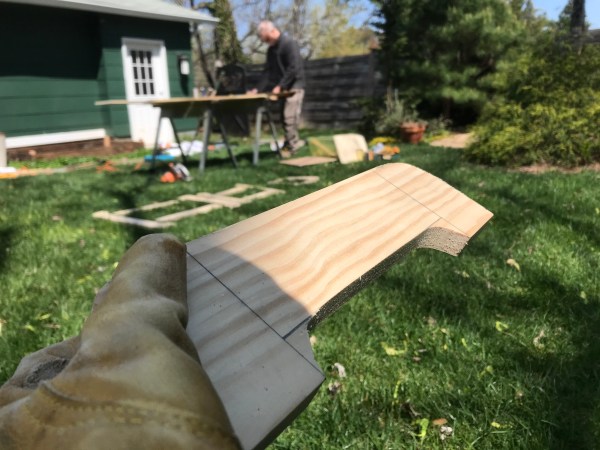
Working on some boat carpentry while Maggie May is self-isolating in the shop. This piece will be part of a hatch frame.

In fact, it may be quite close.  As of last Friday, the biggest part of the project, the complete redo of Maggie May’s hull is finished. The entire boat bottom was blasted off down to the bare fiberglass; new fiberglass and epoxy was applied; and a new kind of long-lasting, less-toxic bottom paint covered all.

The rest of the boat project, which over the past 7 years has included a list of no less than 1000 items, has narrowed to about 20, most of which Bill and I will do. The one holdup is the redo of the previously redone decks, the lingering bane of Vilkas. But we are expecting to see this finished this week, at which point the boat can go outside, get her mast back on, and get in the water as soon as our marina gets an opening in a backlog of boat launches.

We’re so close, closer than we’ve ever been. But given all the stumbling blocks that have arisen and the incredible uncertainty of this moment in time, I don’t think I can muster any excitement until Maggie May is placed back in the water where she belongs.


SV Maggie May: The final countdown

Sailing around the world was a 5-year-plan launched in 2002. It’s now 2020 and we still haven’t left. How did 5 years stretch into 18 you ask? Well let me try to tell you in one blog post.

If you are rich you can buy a new boat, maybe even hire a captain and be ready to launch in a year or two. If you grow up eating government cheese things are a little more complex. This was factor one in the long timeline.

FACTOR 2 The Original Maggie May, the boat’s namesake, might have been able to make an around the world sailing voyage in her youth…she was a spry pup who climbed trees and scaled rocks like a mountain goat. But as she got older she developed arthritis and other ailments and by 2007 (our theoretical departure date) she was almost 10 years old. We didn’t want to put her through life on the boat, and we wanted to enjoy her golden years.

FACTOR 3 There was another important reason. Bill and I are both very devoted to our work. Bill crafted government policy that would help the city of Washington DC become more sustainable and climate responsible. I worked as a photographer and writer to engage the American public in wildlife conservation and ecological protection, including a 10-year+  effort to stop the construction of border wall on the US-Mexico border. While Maggie was healthy, we were content working for environmental conservation.

IMG_0278

Maggie died in December 2012. This was a devastating loss for us. Our triumvirate was broken and in some ways she was the best of us. So we found a new role for her, as inspiration for a dream.

We had long been setting the stage for the sailing trip on the sidelines of regular life. In 2009, we moved into a very small, very cheap and unloved house and rented out our previous house, a 1,250 square foot bungalow. We are pretty good at living simply and cheaply and therefore we save a good amount of what we make. So in 2013 we were ready. We sold our rental house and bought a sailboat. Everything was finally coming together nicely. We would be on our way in a year or two.

We bought Vilkas, the werewolf, in Florida and sailed her up to the Chesapeake Bay in Summer 2013. Our boat search had spanned many years and the werewolf seemed to have the right balance of interior space, hefty build, and care by previous owners, as well as some extras that would be very useful on the trip: life raft, generator, water maker, wind generator, dingy with motor, sails and backups, a relatively new diesel inboard, and a totally redone hull (due to a problem with osmotic blisters). The only problem we would need to address would be the decks, which were original and a bit of a mess, but an easy fix for about $10,000.

What we didn’t know was that the full moon had not yet risen.

IMG_1291
Bringing our new bundle of joy, Vilkas, up from Florida.

I was more excited than I’ve been most of my adult life. Bill was immediately feeling buyer’s remorse and less than excited. There was immediate conflict due to these contrary emotions. And then the moon came out and Vilkas bared her teeth. The only thing in the list of positives that turned out to be positive, so far, was the diesel engine. Everything else was either broken or breaking and the deck repair turned out to cost 10X our boat broker’s estimate. A year or two stretched into 5 as we fixed all the problems and drained our hard-earned savings, but in fall of 2019 we were ready to go. Vilkas had been transformed, or so we thought.

IMG_1737
The first round of repairs for Vilkas

We pulled Maggie May, (newly named but not yet christened), for one last bottom paint job before our scheduled launched in November. When first we set eyes on her,  Bill immediately noticed hundreds of puffy spots on the bottom of the hull. His face turned grey.

“If this is what I think it is, we’re done. The trip is over,” he told me.

Vice on heart. Shake head. Move forward.

I’m usually the optimistic one in boat-related matters so I proceeded to inspect the hull. I poked one of the spots and an oily liquid poured out. I smelled it… vinegar. Weird.

I took out my phone hoping some quick research would throw us a lifeline. Instead, the Google had  dire news about the search terms puffy spots + sailboat + vinegar smell. You have osmotic blisters, aka boat chicken pox, the Google declared in no uncertain terms. And you can expect the cost of repair to be $20-$30K.

IMG_5365
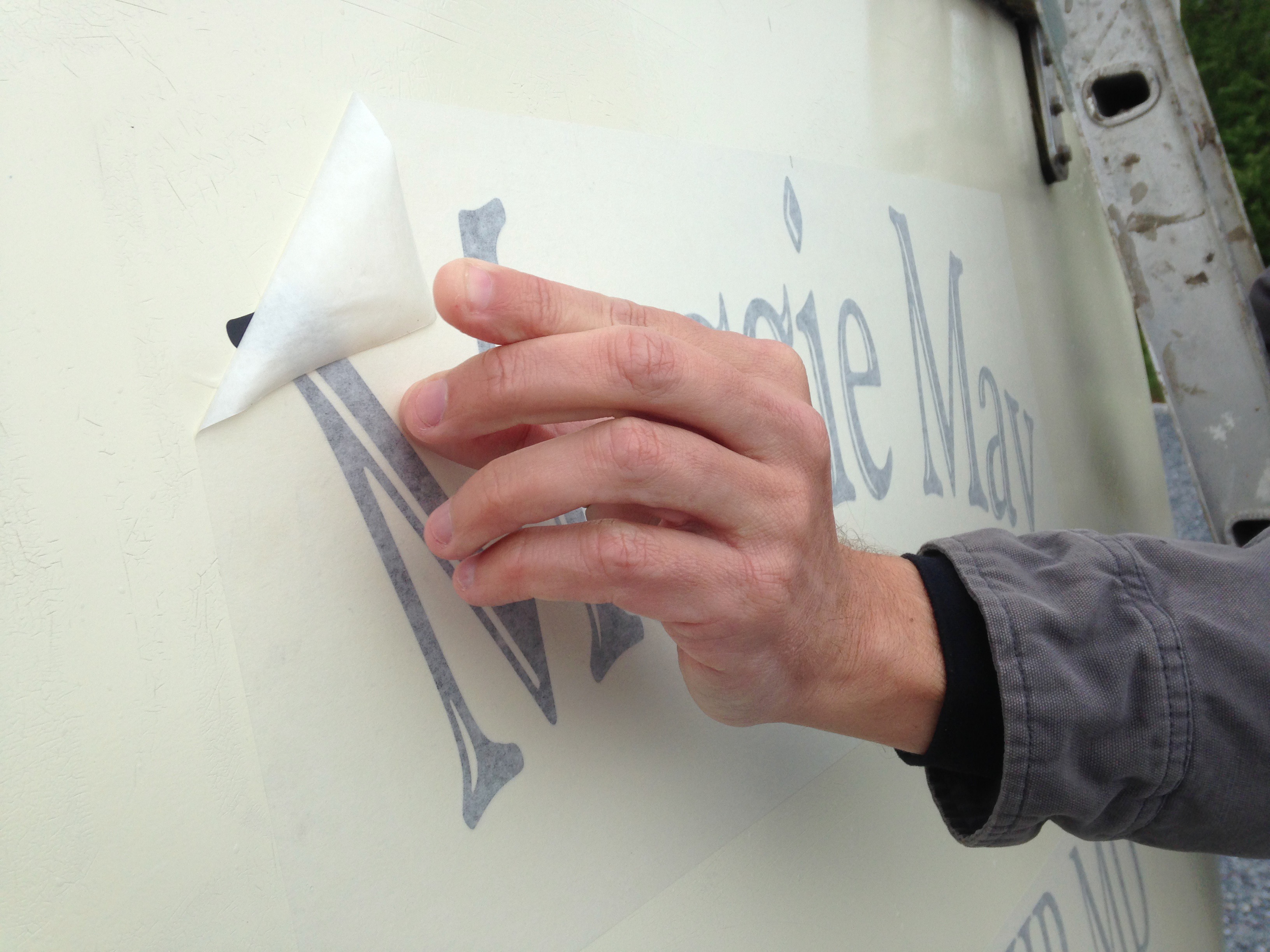
Vilkas is officially transformed into Maggie May

My role over the past 15 years had been to stay positive when Bill was losing faith in the dream. But I couldn’t figure out how to spin this in any way that allowed the trip to continue. What had been more than a decade and a half of planning, and had consumed most of our life savings; what had sustained me through years of heart-rending documentation of environmental destruction, this dream, was going to dissolve into nothing.

Nausea set in so we headed to Burger King, figuring it couldn’t get any worse. We sat down to something like food, and silence.

My mind was mostly blank, but as ever doing some background calculations about what could be done. We had set aside some funds for the trip and some savings to get us by when we returned, until Bill could get a job again. But we had exhausted our budget for fixing the boat. Any further expenditures could put us in a risky position upon our return. We had promised we wouldn’t spend that cushion. And based on our research we would need at least $15K a year while we were sailing. I planned to keep working, writing stories for magazines, licensing photos, but even in a good year I am not our primary earner. I was running numbers when all the sudden a thought occurred to me. We have to fix the boat. 

Even if we could no longer afford to take the trip, we would have to fix the boat in order to sell it and return to our regularly scheduled lives. No one was going to buy a boat with blisters. And we had to fix it right, because the people who repaired this exact problem before we bought it, did not do what was needed for the boat to be permanently fixed. I told Bill as much.

“We have to fix it,” I said. “How about we start there and then later make a decision about whether we can still go?”

Bill was too heartbroken to say much, but he agreed we would figure out the cost of fixing it, and let this new catastrophe percolate for a while.

We ate our fries.

The initial reports from Bill’s research were grim, with estimates at or well above what we had expected. But then he talked to a contractor who said they could do it for less. There was a chance if we could save some money on fixing this, we could still go on the trip, and just eat into our yearly budget and our cushion.

But the issue wasn’t just cost, it was also time. The process of fixing boat blisters right took months. And there was no way it would be done by November 2019 when we planned to depart. Sailing out of the Chesapeake in January can be challenging or impossible but sometimes you get a window in February. This was the best we could hope for. And there was a moment we just looked at each other and said, “This is our dream. We can’t give up on it.”

So we made arrangements to get the boat to the shop in December, the first available option the contractor had. December rolled around and we set everything up…but the machine that would remove Maggie May’s mast so she could fit in the shop was broken, for the whole month of December and half of January.

Finally in January Maggie May was placed in the shop and the work started. We began a two month countdown to our departure. We would finally, after more than 15 years of planning, launch our sailing circumnavigation on or around March 15, 2020.

Enter the Coronavirus.

Confluence Moon

The following text is excerpted from River of Redemption: Almanac of Life on the Anacostia, published in November 2018 by Texas A&M University Press. Each chapter of the book is titled according to the custom of many native North American cultures, to name a month for the defining quality of its days. Anacostia Almanac months are defined by two temporal threads–our present days within particular seasons, and the days throughout time that have led to this moment in the watershed.

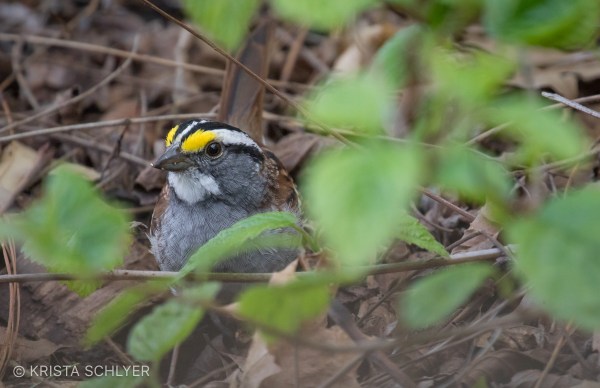
White-throated sparrow

Confluence Moon

For the past week a young white-throated sparrow has been camping out in my yard. His song wakes me every morning, very, very early, before the sun has made the slightest hint of light on the eastern horizon. Before I have any intention of getting out of bed. So I just lay there, awake and listening in the darkness.

Bird reference books often translate the white-throated’s song into the phrase Oh sweet Canada, Canada, an apt description of both the phonetics and the tone of these birds. Theirs is a wistful song constructed of minor notes, as if they are always preoccupied by thoughts of some other time and place, some melancholy memory or remembrance of a long lost friend. My visitor sings throughout the day, distracting me from my work as I would rather listen to him than do just about anything else. Though…I’ve gathered he is a young bird because he seems to be practicing…and in need of practice. Sometimes he gets it right, but often he goes off key or loses pitch entirely or devolves into a whistle. He sounds like a gawky teenage boy whose voice is changing; every time he opens his mouth, what comes out may be a boy’s treble, a man’s baritone, or some crackling squawk that lies somewhere in between. His song lacks the grace and assurance of a mature songster, and he appears to be quite alone. I have seen no other white-throateds for a few days. I doubt his pitiful song has chased them off. By now, many of my winter sparrows have begun to migrate north to Canada. Perhaps he is staying behind to practice before he journeys to the breeding grounds and attempts to woo a lady. That would be a good plan. He’s not ready from what I can hear.

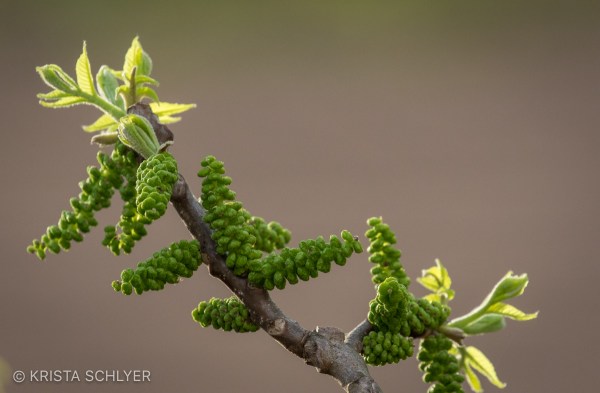
Yesterday I noticed the first buds on the walnut tree outside my back window. A few have already dropped into their bright green bloom, like clusters of tiny green grapes; but most are little more than bare twig with the slightest brown nubs just waiting to sprout. Within days the green thoughts percolating within these nubs will burst forth, attracting the attention of hungry squirrels, and very soon after that, my house wrens will return from points south and begin their seasonal governance of the walnut tree where for years they have raised their young. They will scold squirrels, sparrows, and humans alike if we dare to enter their defense perimeter. I once saw a napping squirrel harangued for fifteen minutes by one of these feisty birds, which are the size of a ping-pong ball and about as heavy. If a squirrel was inclined, one punch of its paw in the wren’s face would send the little ping-pong bouncing, bounce-bouncing. But squirrels rarely seem inclined toward violence, and wrens are disarmingly cute.  This particular squirrel ambled off and found another branch further from the wren house where he could nap in peace.

Life seems to move so fast in these early weeks of April, everything becomes a battle for who will live the boldest and claim the best space for sun and food and shelter. Who will project the moxy that keeps interlopers away from their homes. Who can adapt to changing climates and conditions and still manage to thrive.

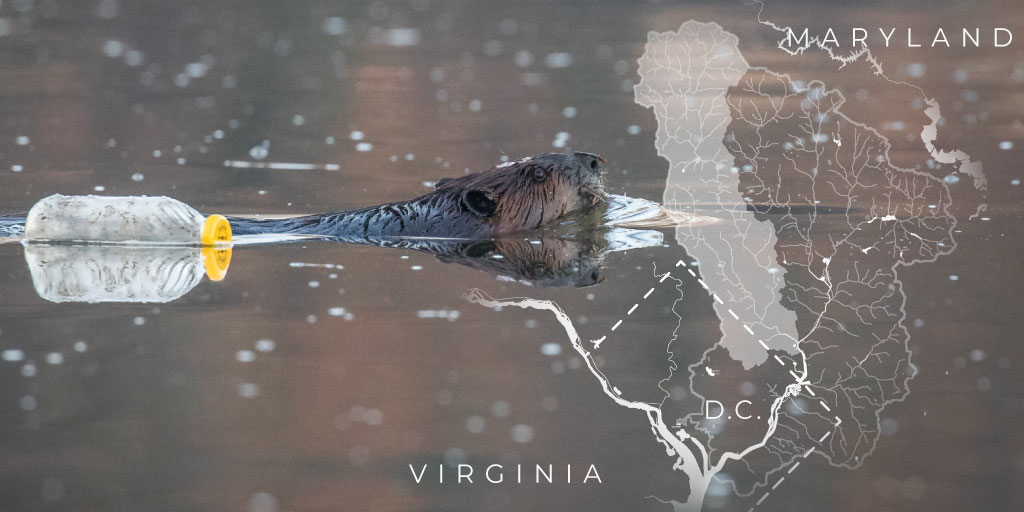
A juvenile beaver on the Anacostia River in Washington DC. Castor canadensis

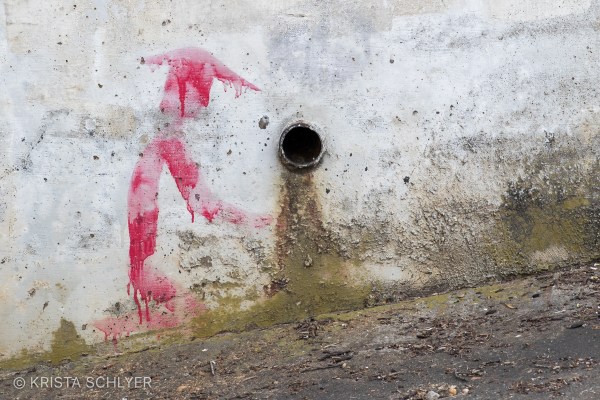
In search of some of this wild life I head out on my bike. On the bridge that spans the Northwest Branch on Rhode Island Avenue, I see a swallow emerge from one of the drains that empties into the river. He flies around for a spell then returns to the hole, apparently having built a nest within. It’s just a small hole, about the circumference of a baseball, about the size of a swallow, in the center of a 30-foot high concrete wall that channels the Northwest Branch toward its confluence with the Northeast Branch. I can imagine that to this little bird it resembles a cave in a high cliff wall, the kind of place his ancestors nested in, though a lot, lot noisier. And here, watching the swallows flying in and out of their concrete cave near the merging point of main branches of the Anacostia, I consider the idea of confluence: two distinct arms, branches, ideas, coming together into one fluid stream. Throughout its modern history the Anacostia has been plagued with issues of injustice and environmental degradation: the felling of ancient forests, extermination of entire species, decimation of the native people, enslavement of Africans, dumping of sewage and garbage in the river, destruction of wetlands, dumping and burning in poor neighborhoods, decades of failure to do right by this river community.

In the 1960s, the struggle for civil rights paralleled the struggle for environmental protections. Both efforts sought to right wrongs, to end realities that were degrading to all involved, and both sought to compel the machine that had been ripping the garden to shreds–breaking the foundational bonds of community apart–to abide by the dictates of an increasingly more enlightened collective mind. Both were successful, to some extent, for out of this time came the legal framework that seeks to guide our river community on ethical environmental and social paths–the Clean Water Act and Civil Rights Act. But through the tumultuous 60s these efforts generally followed their own separate trajectories. At the time of Kelvin’s death, the ties between racism, poverty, and environmental degradation remained disconnected in the national consciousness.

Then in September 1982, the confluence of environment and justice struck the nation between the eyes when a poor, largely African American community lay down in the middle of a Warren County, North Carolina, road. The residents of Afton had protested the siting of a hazardous waste landfill in their community, but they were ignored. Industry and government made their plans to dump society’s toxic wastes on people they expected would have no recourse against them. As trucks filled with PCB-laden soil rolled into town, the residents, and their allies from the Civil Rights Movement, blocked the opening to the new landfill. For six weeks they protested–marching, laying down, standing up, and sitting down, saying no, no, no we won’t be dumped on. In the end they lost, and toxic waste was unloaded on their rural town.

This wasn’t the first instance of a community resisting an environmental insult. Cesar Chavez and Dolores Huerta organized farm workers in the early 1960s to protest exposure to pesticides and other workplace perils in California farm fields. In 1967, African Americans in Houston picketed a city garbage dump where two children had lost their lives. In New York City, 1968, residents of Harlem protested the siting of a sewage treatment plant in their community.

And of course, Kenilworth residents gathered to block the entrance to Kenilworth dump in 1966. But none of these efforts had garnered nationwide attention as protests for environmental equality. Something different happened after Afton’s failed protest. One of the protesters that joined that effort, Washington D.C. resident Walter E. Fauntroy, a long-time civil rights activist, took a decisive step. Fauntroy was by that time serving as the Congressional representative for the District, and though he had no voting rights, he did have the power to request a study from the Government Accountability Office about the siting of hazardous waste facilities. That study, published in 1983, found that three out of four hazardous waste landfills in the Southeast were located in poor and largely African American communities. More studies followed around the nation, and a trend became apparent–if you were economically disadvantaged and a racial minority, you were significantly more likely to have a waste facility in your back yard. Kenilworth dump was the rule, not the exception. There were thousands of Kelvin’s nationwide living, and sometimes dying, in the waste of an indifferent world.


I stand on the bridge watching swallows make do with their concrete cliff home as traffic on Rhode Island Avenue flies by, and the Northwest Branch rolls ever onward toward its confluence. Near the water surface, another pipe enters into the stream, this one with a stain of grime left where polluted water has trickled out for decades. I notice someone has painted the figure of a peasant, holding his hands under the foul pipe, washing.

And out of nowhere, on an Anacostia breeze, the words of a King return to me:

“I have a dream that one day this nation will rise up and live out the true meaning of its creed: ‘We hold these truths to be self-evident, that all men are created equal.’”

Forest in the headwaters of the Anacostia River.


You can buy a copy of River of Redemption: Almanac of Life on the Anacostia at your local bookstore, online booksellers like Amazon, and you can get a signed copy in my online bookstore.

Waking Moon

The following text is excerpted from River of Redemption: Almanac of Life on the Anacostia, published in November 2018 by Texas A&M University Press. Each chapter of the book is titled according to the custom of many native North American cultures, to name a month for the defining quality of its days. Anacostia Almanac months are defined by two temporal threads–our present days within particular seasons, and the days throughout time that have led to this moment in the watershed.

untitled-3769


Fog envelops the upland forest of the U.S. National Arboretum this morning, where a monochromatic quilt of chocolate, café-au-lait, pale beige, and khaki cloth, blankets the woodland floor. Stitched in the shapes of oak, beech, poplar, black gum, and tupelo, they are a memory of November’s final act at the end of last year’s growing season. When the autumn curtain fell, it landed ever so softly here–and here it stayed to gentle the hand of winter; to give warmth to the roots and tiny creatures that slumber through snow and ice in the tired heart of the forest. These leaves are proof positive of things coming up before they fall, of what was and will be again. They blanket a promise the land is hiding under air alive with intrigue, under this watchful fog, November’s guise, a beguiling disguise for a wakeful land.

I crouch low to the ground and lift a corner of the leafy quilt. At first I find…soil. Just sleepy soil. The record of autumns past, of leaves rummaged by little bird feet, sorted and tossed by the busy hands of squirrels, chewed up by ant and worm and an unseen menagerie of insect oddities.  These characters, alchemists all, transform the spent and fallen leaves, the discarded solar collectors of the forest, into growing season gold. They transubstantiate sun and leaf, into life!

Just soil.

And upon it I find no insects crawling. Not one. No tiny skink, or ant; millipede or spider. Just soil–rich waiting, portentous, expectant earth. Soil is nothing. It is everything. As John Burroughs wrote: “The soil is marrowy and full of innumerable forests. Standing in these fragrant aisles, I feel the strength of the vegetable kingdom, and am awed by the deep and inscrutable processes of life going on so silently about me.”

It should be enough to find soil, to rejoice that, in fact, the dirt is right here where I last saw it. But today I seek something else, soil in its next form, transformed by sun and seed. There is no visual evidence, no sign on the forest floor of what lies below, this hidden hope, but I know it is there buried in the brittle brown pages of forest history.

untitled-3937

I lift another hem of the leafy quilt and there it is, my quarry: a small, determined cylinder, the size of my pinky finger and the color of alive; a nascent, newborn green digit, pointing itself with unbreakable determination toward the sun. This coil of leaf is wound so tightly around itself that the only visible evidence that it is not a solid mass are tiny lines that spiral round the outside of the sprout. The coil protects the tender plantling from the guile of winter’s last grasp, from the inescapable uncertainty above the warm earth; leafy layers harbor heat at the heart of the matter. The coil also creates a rigid structure strong enough to part the soil from which it must emerge. Such effort! Though my eyes cannot detect upward movement, I can almost hear it groaning with the strain. This taut, perfect package pushed its way from root through compressed earth, through topsoil and into humus, adding girth to its green self along the journey. It began as a germ. Using the rich decay of millennia of forest life it grew into a pregnant idea of a plant, a thought for a future life unfurled in the sun as a pretty little frog parasol planted in the forest floor.

Mayapple.

I knew you would be there, little green soldier always standing at the front lines of winter’s last stand. You see, war rages in the Anacostia watershed this morning. Noiseless and nearly imperceptible, it is the battle of two epic forces meeting at the boundary of their temporal domains.

Winter has staked an early, decisive claim over this March day, holding an icy hand over the land, bidding tree, insect, and amphibian to sleep…sleeeep. But spring entrenched itself into the soil yesterday and now rises up to meet the dawn calling flower, bird, and fox to wake! Wake! For the moment, neither will give ground and the clash spreads an enveloping fog over the land. I walk upon this misty precipice between restive winter and frenetic spring, imagining I might pinpoint the exact moment when frost surrenders to fecundity.

A week ago we had our first snowstorm of the strangely mild winter, along with bitter gale force winds raging through the watershed. Freezing rain formed icicles dripping like glass from the first rosy buds of redbud trees. The entire river landscape seemed dipped in glimmering liquid crystal.

Anacostia 3-15-17-3061

Transitions in time and thought, great battles between epic forces, do not come easily.

But now the sun lingers longer every day, melting ice from bud and coaxing the first blush of spring onto the fingertips of bare-armed maple trees. In the marshes, red-wing blackbirds and cattails grow bolder: the one flashes ever more fiery shoulder patches and ushers chattering challenges to rivals; while the other begins to push new green spikes through wetland earth. From within the lowland forest at the edge of the river, spring peepers have begun to chorus haltingly, their song charms water snakes, who begin to peek out of their cozy winter holes.

The robins are singing, the redbud has unfrozen, and the osprey has returned to the Anacostia sky. I spied him from my kayak a few days ago and such joy I felt when I recognized his far-off form, to know that against unimaginable odds he has survived his grueling odyssey to South America and back. Anacostia born and bred, his biology dictated that he make a life-or-death gamble on a three-thousand mile journey upon wind and wing. He had to find a safe winter haven, then gamble once again when he took flight for home, that spring would beat him back to the Anacostia. If by chance he had landed here on a city still covered with snow, a river whose fish were locked beneath a sheet of ice, death would have greeted him at the door of his lifelong home. He could not go back to Brazil, weary as he would be. He would have to simply lay down upon the Anacostia earth and melt away.  When the osprey arrives home in March, I know there is no going back to winter. As Aldo Leopold said of the Canada goose’s return to Sand County: “His arrival carries the conviction of a prophet who has burned his bridges.”

Every year, when the osprey returns and the hours of light and darkness are poised in near perfect equilibrium, winter’s pale chill lingers despite spring’s onrushing radiance. When the forest remains asleep but with eyes aflutter, I come to this forested bluff at the edge of the Anacostia, searching. Ostensibly, I am searching for a particular sign of the coming spring, a very small electric green sign that signals the land has marked the approaching angle of the sun.

But I am also looking for something less tangible, something entirely insubstantial but enormous; a pathway of memory to an elusive portal leading to the Anacostia of old.

untitled-9902

Beyond the hem of this forest, the columns of the first U.S. Capitol building rise out of a hilltop meadow, strange and incongruous. The Corinthian columns were originally erected in 1828 on the east portico of the Capital, but as the building grew they became obsolete and were later relocated atop this hill in the Arboretum. A monument can be a reminder of many things. These columns speak of history, of legacy, of the long making of a capital city. Today, in this fog, with the breath of land and river rising to cloak the columns, they also speak of a river landscape long subdued and erased into utter forgetfulness.

Over the past centuries, since before those columns were originally built out of sandstone quarried from Aquia Creek in Virginia, we removed all memory of what a watershed is. We scraped away, paved over, cut down, and carted away our watershed context: dumping dredge on wetlands, putting parking lots over former forests, even covering over the very streams that fed the river–turning gentle babbling waterways into pipes and culverts. We have no memory of what it means to live in a watershed because we can’t see one anymore. Most residents have never considered this absence, because in effect, we have imposed on ourselves an ecological dementia. How do we go forward wisely, when we cannot summon what we left behind? How can we restore the Anacostia watershed if we can’t remember it?

Anacostia 3-30-17-0097At the Arboretum, I look for a conduit to an ecological synapse that has not been fully severed, hoping to conjure the lush land that sprouted as the Pleistocene chill abated, a land that felt the feet of badgers, bison, and wolves, that met the eyes of the first humans who ever set foot here in the Anacostia watershed. It is nothing more than an intellectual exercise–that watershed is gone forever. But the practice offers something important. Here at this spot in the Arboretum, called the Fern Valley Trail, the U.S. Department of Agriculture has endeavored to recreate a piece of that native Anacostia in the upland woods, the forest floor, the bend of a clear creek rushing down the hillside toward the river. There is no place like it in the Anacostia watershed for the density of land remembrance.
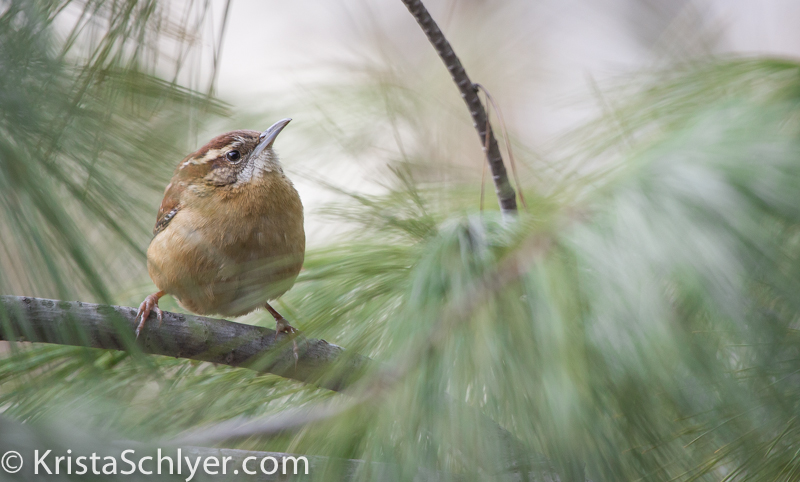
Tourists often come to the Arboretum to view exotic plants from Japan and China: bonsai, cherry trees, Japanese maple, and bamboo. I come to be transported not to a forest a continent away, but rather to my own home, centuries distant and so much further beyond my reach. Here, in this recreated land, it is possible to breathe air that is an echo of an Anacostia unbroken. To find a germ of an idea of what may have been, and thus, a thought, a hope, a prayer for what could be again.

Fern Valley is alive with pulsing synaptic memory of bloodroot, woodland poppy, Dutchman’s breeches, towering sycamore, oak, pine, and maple; of chickadee, kinglet, and owl; assassin bug, butterfly, and beetle.

I keep an eye out every March for the mayapple, a green umbrella beacon guiding the way toward the growing season. I know when I see them pressing upward, that beneath this sea of fallen leaves a whole green and buzzing world is already rising, just below the soil unseen: soon there will be fiddlehead, bloodroot, trillium, spring beauty, trout lily. Long ago these early risers, the first of the spring bloomers were dubbed wake-robins, because it was understood that when they appeared, the long quiet of winter was over, it was time to rise for bird, bee, and butterfly, it was time to wake, robin.

From every slumber there must be an awakening.

***

You can buy a copy of River of Redemption: Almanac of Life on the Anacostia at your local bookstore, online booksellers like Amazon, and you can get a signed copy in my online bookstore.

Fire and Ice Moon

The following text is excerpted from River of Redemption: Almanac of Life on the Anacostia, published in November 2018 by Texas A&M University Press. Each chapter of the book is titled according to the custom of many native North American cultures, to name a month for the defining quality of its days. Anacostia Almanac months are defined by two temporal threads–our present days within particular seasons, and the days throughout time that have led to this moment in the watershed.


Anacostia 1-2014-7930

February: The fire and ice moon

An ashen cloud shrouds Kenilworth Park in cold, gray shadow this morning, casting an especially bleak pall on the asphalt moonscape that sprawls across the southern end the park. Winter wind strikes my face as I gaze westward across a field of pocked gravel and bare turf, toward the sliver of remnant forest that lines the river. The voice of a distant Carolina wren, perched across the river, rings out from the forested bluffs of the National Arboretum. His loud, sweet song lofts along the Anacostia, an optimistic note challenging the drear of the day. I take a few steps toward the little crooner then stop, gazing for one wistful moment in the direction of the quixotic bird. Would that I could go to the river and sit in quiet audience until he has tired of singing; that I could watch clouds dance to the tune of a jaunty north wind, capering along with the river as it rolls on ever toward the sea.

Instead, I force my feet to walk in the opposite direction, obligated by the singular reason I have come here on this particular morning. February 15. The anniversary of bedrock bottom for the battered soul of the Anacostia. What happened here 49 years ago today, the river will always remember.

I turn my eyes to a blank, recently plowed expanse of bare earth to the southeast, stretching 100 yards toward the mouth of the Watts Branch. This ocean of dirt, made heavy by the moist winter wind, and made tidy by machinery over the past week, cannot hide what lies beneath–the last immortal remains of the Kenilworth dump.

It will not be mourned.

For most, it is long forgotten.

Kenilworth Park is a National Park Service property within Anacostia Park.
Kenilworth Park, National Park Service land along the Anacostia River that served as the District of Columbia city dump from the 1940s to the 1970s.

But forgetting a hidden wound doesn’t heal it. No matter how deep we bury this place in the crypt of collective memory, it shadows us, a toxic emotional and ecological undercurrent of our river community, one of those deep hairline fissures set in motion when English settlers followed John Smith up the Potomac, bringing with them the seeds of the Anacostia’s destruction, quite literally.

Tobacco.

Introduced to Europe by Spanish explorers in the West Indies, tobacco had become a hallmark of social status with the ruling class, a superfluity whose sole purpose was to broadcast a personal dominion over the chains of fear and want.

Demand grew as renowned physicians began to lecture and publish articles about the health benefits of this new plant from the colonies—which, according to some was a medical cure-all; a solution to every manner of malady from headaches, constipation, snake bites, and joint pain, to “rottenness of the mouth” and “windiness.”

As news of its prowess spread, tobacco became the economic foundation of the struggling British colonies in the Chesapeake Bay watershed. So central was this plant to colonial success, that setting a minimum price for the commodity was the first item on the agenda at the very first meeting of the first elected governing body in the North American colonies. That meeting of the Virginia House of Burgesses took place at the Jamestown Church in 1619. That same year, the first 20 African slaves were sold in Jamestown.

Up until this time, British colonies had proved themselves hapless in both the growing of food crops and the building of relationships with native peoples. For the floundering colonies, tobacco offered a way out and a way up; a means of transferring wealth and power from Europe to the New World. Wealth would buy weapons for conquest and expansion, food for sustenance, and slaves to produce more tobacco and keep the cycle of wealth and power flowing. With a growing demand and natural scarcity of tobacco in Europe, sales were assured; and the production opportunity in the colonies was bounded only by the supply of labor and land, and a means of transport abroad. In the Anacostia, these bounds could be removed by slavery, suppression of the Nacotchtank, and the river.

Tobacco production in the Chesapeake colonies exploded in the 17thcentury, from 20,000 pounds in 1619, to 38 million pounds at the turn of the 18thcentury, just 80 years later. In the same span of time, the number of African slaves tending the tobacco economy grew from 20 to 700,000.

(c)KristaSchlyer Anacostia-11
Tobacco production in the Anacostia River watershed stripped the land of protective forests and led to silt pollution pouring into the river. Modern development and deforestation continues to add to this pollution. This site at Bladensburg was historically 40 feet deep and crystal clear.

By 1640, both Maryland and Virginia had made tobacco official legal tender–cash money. It’s really no wonder then, why forests were scraped clean off the land: they could be quickly transformed into money that literally sprouted from the ground. For 150 pounds of tobacco, a man might buy more land or a larder full of groceries; or he might purchase an English woman for a wife, or 5 years of the life of an indentured servant, or put a down-payment on the entire life of a slave–all of which would help the planter cut down more trees to grow more tobacco money to buy more land and people.

The tobacco economy that dominated the first centuries of European presence in the Chesapeake Bay watershed destroyed the natural ecology of the Anacostia and other sub-watersheds of the Bay. This once 40-foot deep site of the Anacostia River was polluted by silt runoff from clearcut land.

This tobacco cycle ripped like a cyclone over the Chesapeake Bay and into its sub-watersheds, including the Anacostia, leaving a waste of broken ecological and human communities in its wake. And like a cyclone, the ravaging of the tobacco economy could not be stopped until the forces that fueled it were spent: either demand for tobacco eased, or the supply chain was disrupted. Until then, the pursuit of tobacco riches would continue to scour the land and soil and soul of an embryonic nation, hardening the concrete of a European economic model in which wealth was defined by profits, land, and slaves.

How you define wealth, defines you in turn.


***


You can buy a copy of River of Redemption: Almanac of Life on the Anacostia at your local bookstore, online booksellers like Amazon, and you can get a signed copy in my online bookstore.

La Parida: Where the Wild Things Were

Wednesday morning at dawn a solitary pied-billed grebe paddled through a misty oxbow lake called La Parida Banco in the Lower Rio Grande Valley National Wildlife Refuge. La Parida translates from Spanish as: one who has just given birth, perhaps the most apt description I’ve ever heard for a wildlife refuge. I contemplated this meaning as the little grebe and I shared a cold February sunrise in the North American tropics of South Texas.

Though we occupied the same space, we came to La Parida on different errands: his was a search for food and safety on an island of wild sanctuary within an ocean of human development. Me, I was surveying the site of the first major border wall construction in Texas since 2009, the construction that would devastate the pied-billed’s home.

(c)Krista_Schlyer border-02342

Yesterday, wall construction began. I walked the Rio Grande levee at dawn and instead of the usual hawks, herons, turkeys and orioles, I was greeted by a battalion of law enforcement. I knew by the ripping feeling in my heart that this signaled the beginning of wall construction, a feeling that was confirmed when I saw an excavator arm moving like a giant insatiable insect over the forest. My mind went to the birds that had been building their nests in the forest; the butterflies who had laid their eggs on the underside of leaves hoping to keep them safe from predators; the tortoises and snakes in the brush, the bobcats and coyotes quietly hunting shrews and cottontail.

Grief has made itself a home in the borderlands of late.

(c)Krista_Schlyer-02330
La Parida – She who has given birth. A tract of the Lower Rio Grande Valley National Wildlife Refuge.

But my thoughts were quickly interrupted by a by a Border Patrol agent, kindly telling me to leave. I backed slowly away, eyes still on the arm of the excavator moving purposefully over the forest just beyond a long line of Border Patrol and other law enforcement officials.


My walk back to the parking lot in Bentsen state park was one of my lowest moments in the past ten years. I have been documenting the US-Mexico border for more than a decade, since the Secure Fence Act of 2006 mandated the construction of more than 700 miles of border barrier through one of the most important biological regions on the continent. [See Embattled Borderlands ]

Kit foxes in Janos grassland, Mexico.
Kit foxes in borderlands of Chihuahua and New Mexico.

This land provides home to the highest diversity of birds and butterflies in the continental US; five of North America’s six cat species; resting and refueling for 700 migrating animal species; and a last hope for some 100 threatened and endangered species, including Sonoran pronghorn, desert tortoises, cactus ferruginous pygmy owls and many more whose futures are tied to this land. [see this report by the Center for Biological Diversity]

That future hangs by a fragile thread. In 2018, Congress approved $1.6 billion for wall construction on the border. Last spring, the Trump Administration began building wall in New Mexico. Construction began yesterday in La Parida. Surveyor stakes have been planted delineating the “enforcement zone” where forests will be cut. And Congress is adding another $1.3 billion in border wall funding in 2019 in order to avoid another government shutdown. Several locations in the Valley have been given a reprieve in this legislation, but not the Lower Rio Grande Valley refuge, not La Parida, she who has just given birth.

borderlands-0633
Javelina at border wall in Arizona

The ecological stakes of this political bartering have been well documented. Since the 1990s the US government has constructed about 400 miles of solid barrier, through the 2,000-mile borderlands. This wall has severed migration corridors for endangered bighorn sheep, ocelots, jaguars and wolves, caused damaging floods, degraded fragile watershed ecology, and fragmented and destroyed tens of thousands of acres of habitat essential to wild species.  The barriers and habitat loss come at the worst possible moment, as climate change is exacerbating the frequency and intensity of droughts in the Southwest–a time when wild species’ best hope of survival is the ability to migrate.

These threats would normally be prevented by bedrock environmental laws like the Endangered Species Act, Clean Water Act, and National Environmental Policy Act. But a provision in the Real ID Act of 2005 allows the Department of Homeland Security to waive all laws to expedite building of a border wall.

Great kiskadee with a granjeno berry
Great kiskadee eating granjeno berry in Lower Rio Grande Valley wildlife refuge. (c)Krista Schlyer

Here in the Lower Rio Grande Valley the direct damage of habitat fragmentation and destruction is compounded by a history of large-scale agriculture, energy and residential development. More than 95 percent of the native habitat in the Valley has been replaced by agricultural fields, oil wells, wind farms, roads, subdivisions, and shopping centers. Within what remains of this endangered ecosystem, one of the most unique wildlife communities on the continent fights for survival. South Texas sits within a natural borderlands at the overlap of the north and south of the natural world, where temperate bird, butterfly, mammal and reptile species coexist with their tropical cousins.

It would be hard to overestimate the natural value of the La Parida refuge. It is one piece of the larger Lower Rio Grande Valley National Wildlife Refuge, a collection of the most valuable ecological lands along the last 275 miles of the Rio Grande. The refuge began as a desperate attempt to save what was left of a vanishing ecosystem. Decades of work, thousands of volunteer and staff hours, and many millions of dollars have created what is now one of the most important wildlife corridors in the country. Refuge land and state parks, along with private preserves like the National Butterfly Center, offer one last hope for thousands of wild species. But this corridor along the Rio Grande sits directly in the path of the border wall, which will be built on the Rio Grande levee.

Few in the United States have ever heard of La Parida, but this refuge has given birth to the grebe, kiskadee, green jay, ringed kingfisher, red tailed hawk, bobcat and javalina. This land is essential. It is home. It is life. But as I look across the water to the Rio Grande levee where construction equipment moves over the land, I see death on the horizon.

You can help.

Come and protest the desecration of the Rio Grande Valley-noon, Saturday, 2-16-19 at Bentsen-Rio Grande Valley State Park. If you can’t come, call your members of Congress today or write an op-ed for your local newspaper. Be a voice for the borderlands.


Krista Schlyer is a conservation writer and photographer and author of the book Continental Divide: Wildlife, People and the Border Wall.  She is currently working on a film with Jenny Nichols and Morgan Heim called Ay Mariposa, which tells the story of two fierce women and a community of butterflies on the front lines in the battle against the border wall.


Border Angels vs Excavators

Like many South Texas mornings, yesterday’s dawn was sung into existence by Altamira orioles, great kiskadees and green jays, warblers and cardinals.  It’s hard to imagine any hurt could go unhealed in a world where the birds chorus at dawn. So it seemed for a brief eternity as I walked west through the northern edge of Bentsen-Rio Grande State Park, along the Rio Grande levee.

(c)Krista_Schlyer-01645
Wild turkey at the site of the future border wall in Bentsen-Rio Grande State Park, Mission, TX.

I stopped for a moment on a low bridge over an irrigation canal to watch the just-risen sun peeking out from behind restless clouds moving with some easterly haste. And it was then I felt it, I was being followed. You know the feeling. I get it often while traveling in the borderlands, usually because I’m actually being followed by border patrol. But this feeling was one of anticipation, not the frustration or mild rage that border patrol provokes in me. And when I looked down the canal, into the light morning mist, what I saw made my heart quiver–a troupe of ridiculous wild turkeys shuttling along the canal bank toward me. I crouched low on the bridge and waited as they approached in unhurried fashion, stopping briefly every few feet to inspect the grasses for food.

When they were less than 20 feet from me, one of the turkeys gave his wings a grand flourish, catching the morning sun for one perfect translucent moment. Angelic he was, a regular borderlands angel. And then the moment passed and the troupe walked up onto the levee and continued on its way.

(c)Krista_Schlyer-01671
Wild turkeys on the Rio Grande levee, planned site of border wall construction.

And I returned to the reason why I had gotten up before dawn to walk down the levee. It was not to hear the orioles or greet the angels, that was just fortune’s mercy. No, this spot, where these turkeys are traveling through their habitat, their home, their source of sustaining food, water and shelter, this is where the border wall will soon be built.  And it could happen any day. (c)Krista_Schlyer-01005

I followed the turkey’s path along the levee west of Bentsen park to the La Parida tract of the Lower Rio Grande Valley National Wildlife Refuge. When I reached the refuge I found just what I had come to see, but hoped I’d never find: surveyor stakes lining the levee and an excavator parked next to the National Wildlife Refuge sign. Within days it is expected that this machinery will begin to tear down the trees where the orioles are building their beautiful nests and laying their eggs, and scrape the land where threatened Texas tortoises and Texas indigo snakes are resting and hunting, and pour 20 feet of concrete wall into the Rio Grande levee.

(c)Krista_Schlyer-01012
Excavator on the Lower Rio Grande Valley National Wildlife Refuge, South Texas.

As I was looking at the construction machinery a National Wildlife Refuge law enforcement truck approached and the officer told me to move along, that I was not supposed to be there. (I held my tongue and moved along, but I wondered to myself about his job description, which is supposed to entail protecting wildlife refuges from destruction.)

The money for this segment of border wall construction was approved by Congress in 2018. The day after the bill was signed Senator Chuck Schumer and then Minority Leader Nancy Pelosi declared that they had defeated Donald Trump and not included border wall in the budget. The national news media repeated their claims. And yet here I am, staring at the machinery that will raise a combined 30 feet of concrete and steel through this sanctuary of wild life.

This wildlife refuge, along with the Bentsen state park, the National Butterfly Center and hundreds of other tracts of public and private land, are part of a 30-year effort to try and save a vanishing ecosystem, one of the richest and rarest ecosystems in the United States–from utter destruction. The environmental stakes couldn’t be higher here. Two of North America’s major avian flyways funnel through the Rio Grande Valley, as do major migration pathways for monarchs and other butterfly species, and migration pathways for endangered cats. These migrants depend on the spare remnants of habitat that are left to them and that Valley residents, the federal government, and national environmental groups have been trying to save for decades. And now we are preparing to scrape this precious land to the bone and further fragment it with massive border walls.

untitled-06372
La Lomita Mission Chapel, Mission Texas

I went to a dawn vigil this morning at La Lomita Chapel, a historic church that is also in the path of the border wall. (The church has been fighting the federal government’s taking of the mission land through eminent domain.)

The priest saying the mass, Father Roy, spoke passionately about the wrong-headedness of the wall and about the foundational Christian teachings that demand an open heart and hand towards those who need your help. It was a stirring speech, but what reached me was not the affirmation of the core religious and humanist beliefs of generosity and love, but Father Roy’s caution that we not let anger over this impending desecration overcome us. We must maintain a core of peace and love, or be destroyed by rage against those who are most responsible for this.

As I have heard Van Jones say, ‘When it gets harder to love, love harder.”

But it is getting harder and harder with every dollar Congress gives to president Trump for border wall construction; with every denial by the Democratic party that they have done so; with every news story that parrots this Washington DC delusion; with every new piece of machinery that arrives at the border and every new surveyor stake that is planted in a land of living sanctuary.

It is getting harder and harder to love. And I’m not sure my border angel and his winged compatriots, who depend on this land for their very lives, think peace is the best option at this point.

Congress is working on another deal behind closed doors. They are discussing what to call the border barriers they are sure to fund if we keep the peace rather than making it very uncomfortable for them to fund more wall. Please call your senators and representative today. Congressional switchboard: (202) 224-3121
For more information about the history of the US-Mexico borderlands, visit: Embattled Borderlands. Or get my book Continental Divide: Wildlife, People and the Border Wall. And look for Ay Mariposa, a new film coming out this spring.


Border Wall Construction Begins, again

89. Wildlife refuge staff Nancy Brown at a wall construction site.
2008 Border wall construction on the Lower Rio Grande National Wildlife Refuge in South Texas.

This year marks the 30th anniversary of the fall of the Berlin Wall. I can still hear Americans cheering when Ronald Regan demanded “Mr. Gorbachev, tear down this wall!”

Today is also the 10th anniversary of a much lesser known historical event — the Borderlands RAVE. It was an expedition I organized with the International League of Conservation Photographers, focused on raising awareness of the beauty and biodiversity, value and vulnerability of the US-Mexico borderlands after the passage of the Secure Fence Act of 2006.

There were 15 of us on that trip, some of the most committed photographers, scientists and filmmakers I’ve worked with. We traveled the border from San Diego to Brownsville from January 19 to February 19 of 2009. We documented some of the most exquisite beauty and rarest habitat in North America; stayed with border residents who opened their homes to us and shared their stories of love for their homeland on the border. We were detained by Border Patrol and by flat tires and desert sand. We slept under the endless desert sky.

Prairie dog family in northern Chihuahua Mexico.
Prairie dogs in the US-Mexico borderlands.

The last days of the trip were spent in the Lower Rio Grande Valley, where less than 5 percent of native habitat remains and border wall construction had already begun to fell forests and scrape the land bare, leaving no secret passageways or gentle quarter for endangered ocelots and jaguarundis; setting the stage for massive flooding that would drown imperiled Texas tortoises in 2010; and diminishing an already nearly vanished refuge for birds and butterflies.

borderlands-5323

When the trip ended we had gathered thousands of photographs, undeniable evidence of the importance of the borderlands and the threat that a wall posed to them. I believed then that if we just showed Congress our evidence, that this kind of destruction would end. In March of 2009, I created an exhibit of our team images and worked with Defenders of Wildlife, the Sierra Club, Center for Biological Diversity, Mennonite Central Committee and friends and family to install the exhibit in the House of Representatives. We had a reception and briefing, where many members of Congress came to speak of their opposition to wall. We did the same thing in the Senate in November 2009, on the 20th anniversary of the fall of the Berlin Wall. And senators came to speak about their opposition to the wall. We had a newly-elected president who, when he was campaigning, had said:

The walls between the countries with the most and those with the least cannot stand. The walls between races and tribes, natives and immigrants, Christian and Muslim and Jew cannot stand.”

But President Barack Obama had voted for the Secure Fence Act, and he would continue to build the border wall that George W. Bush had started.

Flash-forward 10 years: I left my home in Washington DC this morning and got on a flight to South Texas where border wall construction in the Rio Grande Valley is starting up again. Donald Trump has become the fourth successive president, starting with Bill Clinton in the 1990s, to expand the US-Mexico border wall. Trump will, like the others, start on National Wildlife Refuge land, because it is easier to destroy the homes and futures of wildlife than to take land from Texans. Trump will also take private land, but he will start with the low-hanging fruit, public land, where he has already waived the Endangered Species Act, Clean Air Act, National Environmental Policy Act and every other law that would impede construction. Congress gave the executive branch that power under the Real ID Act of 2005.

borderlands-0678
Desert cottontail near border wall construction in 2008, San Pedro National Riparian Corridor, Arizona.

Tomorrow I will witness and document the destruction of forests where birds have begun to construct their nests and butterflies have laid their eggs; they will be torn down by machines funded by American taxpayers.

My first instinct is to end with something snide, like: Happy Anniversary.

But that would suggest it’s possible to simply shrug off this moment, and accept walls as an inevitable feature of the modern world, along with mass extinction of Earth’s biodiversity, climate chaos and nationalism. It isn’t and they aren’t.  So instead I’ll end by asking every person who reads this to make a phone call to their members of Congress, because one thing I’ve learned is that politicians don’t do things because they are right or wrong, they do them because their constituents demand it.

For more information about the history of the US-Mexico borderlands, visit: Embattled Borderlands. Or get my book Continental Divide: Wildlife, People and the Border Wall. And look for Ay Mariposa, a new film coming out this spring.


The Deprivation Moon

The following text is excerpted from River of Redemption: Almanac of Life on the Anacostia, published in November 2018 by Texas A&M University Press.

At icy dawn, the city remains gentled in night’s deepest repose. Walking past slumbering bungalows and a shuttered gas station, through deserted streets, across empty railroad tracks and along the edge of a sleepy forest– I traverse a dark, noiseless mile to the frosted footbridge at Bladensburg Waterfront Park.

Upriver, near the confluence of the Anacostia’s northwest and northeast branches, hundreds of Canada geese huddle together, raising a dark feathered shield against winter’s white knife and its unusually sharp edge this January morning. Last night an angry north wind descended on the watershed, driving temperatures to a low of minus 11 degrees Fahrenheit, more than 20 degrees below normal.

Today’s river landscape testifies to the hard hand of that north wind. At low tide a rigid silt sandbar covers the west side of the riverbed, and a half-inch of ice caps most of the remaining water surface. Downstream, the river departs to the southwest through a luminous white forest, gleaming toward the heart of Washington D.C.

I stand at river’s edge in Bladensburg, Maryland, once one of the busiest shipping ports in North America, a nucleus for trans-Atlantic trade in tobacco cultivated by the hands of enslaved Africans. This soul-weighty cargo succored a fledgling British colony and fueled an American revolution, all while sending a webwork of moral and ecological fissures spidering through the foundation of a young nation.

The thought sends a tremulous chill through my bones, though the Bladensburg waterfront before me bears little witness to this tortuous historical fault line. A few memorials to the War of 1812 are all that’s left as direct physical reference to what happened here, and day-to-day this humble space exists as a much-loved nexus for people and the Anacostia River. But in the silted shallow riverbed and bare-turf landscape, the river remembers.

On a slow stroll along the park’s riverside walk, I step out onto a floating pier, where I encounter a single Canada goose asleep on the cold wooden platform. I stop, wondering why he is separated from the larger flock and surprised that he has not been roused by my presence. Inching a few feet closer I observe that the morning frost, which has settled on the river landscape, its trees, riverbank, and pier, has also laid a glittering glaze over the goose himself, whose head is locked tightly in the thick down of his back. When I approach within a few feet of the bird, he still does not stir. I reach out, tentatively, and lightly touch a tail feather, preparing myself mentally to be scared witless when the goose awakens.

The feather crunches beneath my finger–the goose remains utterly still. Here is a sleep my winged friend will not be waking from.

Leaving the bird to his eternal rest, I make my way to the bank on the opposite side of the river. Ring-billed gulls have gathered on the western shore, tapping their beaks softly against the thin crust of ice covering the mud flats, searching for soft-bodied creatures in the warmer earth below. Gulls are argumentative, pushy birds by nature, but today they are solemn and respectful of each other, and barely bother to look up when I approach. In this deep cold, there exists a momentary truce. We are all too busy surviving the deficit of light and warmth to meddle in each other’s affairs. There is too much to lose in January.

We all, each Anacostia and Earth resident in our own way, have strategies for surviving the deprivation moon. And in this month of scarcity and dark vulnerability, we each harden our creaturely resolve and lean, as ever, toward a universal prime directive– what Aldo Leopold called, “freedom from want and fear.” It is a desire never attained in life, not really, but ever sought-after for all who move about on this planet, whether they are rooted to the earth and reaching toward the sun, or walking, flying, or swimming in search of life’s next pressing need. This elusive prize fuels our action and existence, from humble subsistence to greedy conquest. How a creature or community pursues this fundamental freedom, will ultimately define it.

Leopold’s anxious ambassador for this universal endeavor was a meadow mouse, gleefully building his snow tunnels and food storage rooms, gathering his brittle brown grasses, all in the safe obscurity of winter’s white cloak on the Sand County land.

“The mouse is a sober citizen who knows that grass grows in order that mice may store it as underground haystacks, and that snow falls in order that mice may build subways from stack to stack,” Leopold wrote.

For mouse, unlike goose and gull, a long harsh winter offers rest, a relative reprieve from the ever-keen eyes of winged predators. It is here, under the deprivation moon, he has a frosty window on a world free from fear and want. For this clever mouse, snow is a building material and shroud for protected transportation pathways out of the eyesight of raptors, and for storage rooms to house a larder of grass for a well-fed winter mouse. The hawk, whose great advantage of speed and vision is stymied by the snow, will hold on over hungry months, awaiting a warm spell or the spring thaw, when mouse pathways are generously revealed, and another winter has passed into spring–a season of increasing freedom from fear and want.

Gull flying over the Anacostia River in winter.

My Anacostia gulls, if they live through this trying winter, will surely experience a similar spring euphoria, and will undoubtedly squawk and caw about their spring fortune loudly and often. I anticipate shaking my head and rolling my eyes at their brash boasterisms sometime in a near warmer future, but in truth, they will then have earned bragging rights. Though they themselves are not modest, gull, like hawk and mouse, seek a modest fortune, nothing more than freedom from hunger, and a sheltering space insulated from the icy grasp of death. They harbor no desires for superfluous luxury, their pursuit is simple–they want only a chance at life in all its luminous elemental dimensions.

Today, that pursuit demands determination, discomfort, and an efficient stillness. Gulls keep their wings tucked tight, voices quiet, and heads down.

I do the same, substituting arms for wings, and leave them to their winter misery.

On normal days, even in winter, attempting to walk out onto the silted shallows of the Anacostia would be treacherous. Many have died in the urban sludge that has accumulated on the Anacostia bottom over the past four centuries of America’s pursuit of freedom from fear and want. Our proclivity to hound every manner of superfluity led to the felling of ancient forests, silting of the river and elevation of the historic riverbed some 40 feet–bringing an end to the bustling port of Bladensburg. It is now almost beyond imagining that ocean-going ships once docked at this spot on the river.

I test the earth of river bottom and find it icy-firm, a rare opportunity to experience a moment within the arterial wall of the Anacostia. We are all, always, within the body of a river. Every upland and lowland inch of the watershed plays a part in the river system, from my own backyard, to the headwaters at Sandy Spring in Olney, Maryland, to the smallest trickling capillary entering into the Watts Branch. But here, upon this artery at river-heart is where it all comes together.

On any given day the Anacostia, like all rivers, is ever new. It is the same water course, but eternally changing and ever changed, reinvented by moods of wind and weather, the magnetic pull of the moon on its waters, the restless angle of sun’s illumination, and the wingbeats, splashes, and songs of its wild inhabitants.

I stand in the middle of a unique moment flowing together with an infinity of distinct river moments–there is a timeless surge of power here that jolts the senses and urges me forward.

Cautiously I test each step before I take it, and when the river begins to give beneath my weight, I go no further. By this point I am nearly standing in the middle of the Anacostia and can view the sculpted work that winter wind and restless tides have made of the river. The deep freeze that came in the night during a higher tide capped the river in thick ice, but when the tide began to go out and the air began to warm, rigid sheets of Anacostia began to buckle and break apart, like a river-puzzle–each piece now set aglow at the edges by the subdued light of a far-distant sun.

The fractured ice gives new voice to the Anacostia, a grumbling, groaning river-resentment as tide and current jostle the river’s assemblage of broken ice sheets.  But the real river drama must have happened sometime in the dark early morning hours, when shifting tide and climbing temperatures pried the largest pieces apart. This thunderous cracking, for a massive volume of water must have be something to hear–a soundtrack echoing the epic ecological dynamism that over so many eons of fire, ice, water, and wind–of continents colliding and seas ever-rising, ever-falling–created and continues to recreate this river watershed.

Somewhere in the earth beneath my feet there lies a record of the grand incomprehensible ages of river life. Somewhere, running deep beneath the riverbed, back through time beyond reckoning, it leads down to a primal era where river life radiates in its purest form, from some ancient infernal source, through a billion years of rock, clay, sand, and silt. Down 50 feet, 100, 500, 1000–there lie the hallowed earthen halls of river memory.


***


You can buy a copy of River of Redemption: Almanac of Life on the Anacostia at your local bookstore, online booksellers like Amazon, and you can get a signed copy in my online bookstore.

Anacostia River Web Series Launches Today

River of Resilience story map commemorates the Year of the Anacostia by exploring the history and restoration of a national river watershed.

Over the past four centuries the Anacostia River has been given many names: the Eastern Branch of the Potomac, the other national river, the dirtiest river in the nation, the forgotten river. But for millennia uncounted prior to European arrival, for every creature that lived within the watershed, this river was simply everything.

How does a river transform from essential to forgotten in a span of 400 years?

This question is one of many addressed in River of Resilience, a nine-chapter web story structured as a journey from the headwaters of the Anacostia in Sandy Spring, Maryland, to the confluence of the river with the Potomac in Washington DC. River of Resilience is a story of time and place, a visually-rich geographic narrative of a wounded but irrepressible watershed, a story of those who are working to heal this river community, and an entreaty to join them.

The project features the writing and photography of Krista Schlyer, a senior fellow in the International League of Conservation Photographers, and author of the forthcoming book River of Redemption: Almanac of Life on the Anacostia, due out fall 2018 from Texas A&M University Press.

TrashinRiver

The River of Resilience web story was created in partnership with Esri, creator of ArcGIS, using their story map platform Cascade, and data-driven maps created by the Esri story maps team. The project was funded by the District Department of Energy and Environment in collaboration with the Anacostia Waterfront Trust.

River of Resilience launches today, April 3, 2018, with new chapters released each week through May 29, 2018.

Join the Anacostia River journey here.


River of Redemption: Almanac of Life on the Anacostia

Incorporating seven years of photography and research, River of Redemption portrays life along the Anacostia River, a Washington, DC, waterway rich in history and biodiversity that nonetheless lingered for years in obscurity and neglect in our nation’s capital.

Inspired by Aldo Leopold’s classic book, A Sand County Almanac, Krista Schlyer evokes a consciousness of time and place, inviting readers to experience the seasons of the Anacostia year, along with the waxing and waning of river’s complex cultural and ecological history.Schlyer_jacket_web

Blending photography with informative and poignant text, River of Redemption urges readers to seize the opportunity to reinvent our role in urban ecology and to redeem our relationship with this national river and watersheds nationwide.

The book is now available at Politics and Prose, Kramerbooks, and online booksellers like Amazon.

Reviews of River of Redemption

“Krista Schlyer rediscovers a treasure in our nation’s capital, the Anacostia River. A gifted story teller and photographer, she leads us on a moving expedition of human failure and the miracle of nature’s renewal.” –TOMMY WELLS, Director, DC Department of Energy and Environment

“Krista Schlyer has woven her way into the soul of the Anacostia with poetic prowess….a symphony of beauty through words and photos.” –BRENDA LEE RICHARDSON, former Director of Earth Conservation Corps


RIVER OF REDEMPTION SYNOPSIS

Seventy years ago, when Aldo Leopold was writing his prophetic essays in Sand County Wisconsin, the culmination of all his fears was unfolding on the banks of the Anacostia River in Washington DC. The river’s ecological fabric had already been torn from every possible angle. It had been channeled, walled, deforested and dumped on. While Leopold was writing about the meadow mice and oak trees of Sand County, the National Park Service was lending out the banks of the Anacostia as a dumping grounds for the refuse of the nation’s capital. That garbage was burned every afternoon in one of the city’s most impoverished neighborhoods. On the banks of the Anacostia came the violent collision of colossal failures in ecology and justice–all brought to a painful nadir in 1968 with the death of a small boy named Kelvin.

A bald eagle on the Anacostia River, Washington DC.

Just three hundred years earlier the Anacostia had been a living, breathing artery of life for the Nacotchtank people, but in a wink of time we transformed it into a toxic channel and dumping grounds.

The profaning of the Anacostia was made possible by one factor, forgetfulness.

In our Anacostia amnesia we forgot the beauty of an old growth forest, the joy of jumping in a clean river on a hot summer day, the thrill of seeing a bald eagle soaring high above the earth. We forgot the satisfaction of struggling to haul a healthy fish out of the water, and the simple pleasure of sitting on a riverside and gazing down into a clear water-sky to watch turtles fly with perfect, impossible grace. But most of all we forgot that we are a part of a community of land, water, air, bird, mammal, fish, amphibian and insect. We forgot that this river watershed is our community, a community in which every single resident has both rights and responsibilities for the common good.


River of Redemption  is a book aimed at remembering our fundamental relationship with rivers, and imagining a future where that relationship will be restored.

The book was published in November, 2018. You can buy it at Politics and Prose, Kramerbooks and on Amazon and other online booksellers, or order a signed copy today in my Book Store.

You can also read excerpts from the book by clicking on the River of Redemption submenu of the Anacostia Project tab.

Ay Santa Ana

Santa Ana and the battle for sacred ground

There are some places in this world where life and beauty effervesce from the ground itself, places we simply can not lose. There are landscapes where lines must be drawn in the proverbial sand and we must say, no, you will not take this from the world. Not on our watch. Many such places exist in the US-Mexico borderlands, and Santa Ana National Wildlife Refuge is one. Here is a place people will lay down their bodies to protect. It is that rare, that special. I want to show you why.

I wrote a poem about Santa Ana National Wildlife Refuge in South Texas, and worked with a talented group of filmmakers–Allison Otto, Jenny Nichols, and Morgan Heim–to translate it into a short film. Please take a look.


President Donald Trump has been banging his nativist drum demanding billions of dollars for a border wall. Congress has been deal-making and deliberating behind closed doors, preparing to bargain away the future of the borderlands in exchange for the Dreamers held hostage by the Republican Party. I don’t believe any of them know or care about what they are sacrificing to the altar of political power––all for a wall that will have no effect on human migration but will destroy one of the rarest eco-regions on Earth.

Please share this film with your friends and family, with your members of Congress. Pick up the phone and tell your Congressional representatives: the border is not a bargaining chip. The Dreamers must be saved from exile from the only home they have ever known, and the borderlands must be protected from border walls, fences and militarization. #noborderwall #saveSantaAna #cleanDreamAct #aysantaana.

The number for the Congressional switchboard is: 202-224-3121

The 75th anniversary of Santa Ana National Wildlife Refuge is January 27. Many hundreds of people will be journeying to South Texas for a special rally for this endangered landscape. Santa Ana needs our help. If you can join us, here is some information about the event: https://www.facebook.com/events/419603675122981/ . If you cannot travel to South Texas, please take some action for Santa Ana the week of January 27.

For more information about the peril currently posed to the US-Mexico Borderlands, visit my web story: Embattled Borderlands.


Memoir about journey through nature inspires

Thanks for this review of Almost Anywhere Monica Lee-really appreciate your thoughts on the book!

Monica Lee's avatarMonica Lee

The only I didn’t really like about Krista Schlyer’s memoir was the title, Almost Anywhere: Road Trip Ruminations on Love, Nature, National Parks, and Nonsense, because that makes it sound vague and light-hearted.

And it’s really not.

almost anywhere.jpgAlthough at times it is funny, that’s true (one reviewer called it a cross between Wild and Let’s Pretend This Never Happened). But Schlyer writes about her husband who (spoiler alert) died, so hers is a story about grief, too.
She writes so beautifully and specifically about her husband, her dog Maggie and the wonders of some of America’s amazing national parks that I can’t recommend this memoir highly enough. My sister gave it to me for Christmas. And it was a great gift.

Schlyer is writing about a nearly year-long journey living out of a station wagon and tent-camping at every national park, historic site, forest and wilderness she and her friend Bill…

View original post 105 more words

New Film: Border Walls and Boundaries

The US-Mexico border wall boondoggle didn’t start with Donald Trump. Despite its exorbitant cost, wasteful, ineffective nature, and destructive impact, all of the current presidential hopefuls – on both sides of the political spectrum – have voted in support of border wall on the southern US border. Bernie in 2013, Hillary in 2006, Ted Cruz every chance he gets. There are many reasons why Americans could resent this reality: the waste of billions of our taxpayer dollars over the past decade; the useless, farcical nature of walls as a means of stopping people from moving across the landscape; the thousands of migrant deaths it has led to on our southern border; the environmental destruction it has brought to many national parks, wilderness lands and wildlife refuges. This film is about one reason, one very important reason why building a border wall is not worth the cost.


National Parks: Celebrating a Sentinel of American Memory

Krista Schlyer writes on the beauty and memory of National Parks. “It isn’t just beauty we see in these places, and in infinite others in the National Park System–it’s memory. Memory of anoth…

Source: National Parks: Celebrating a Sentinel of American Memory

This is a rant, be warned

I took a few hours last night to participate in my local government by attending an input session for the Prince George’s County, Maryland, master plan for environmental, rural and agricultural conservation. There are of course many ways to get involved in the future of the little spot of Earth I occupy, but I think there is something especially encouraging and meaningful in understanding and trying to effect the land planning process.

Marbled salamander
Marbled salamander

These are plans that will affect the next decades of my county which spans the ultra-urban Anacostia River watershed, my great love, to the rural Patuxent River watershed, and south to the Potomac River. Some of my most favorite friends live in these lands, from the great blue heron and marbled salamander to spring peepers and northern brown snakes. For watershed health, wildlife habitat and ecosystem restoration, these plans could have a greater effect than anything else going on in my county, either for good or ill. Bad planning in the past has effected heartbreaking consequences, everything from the further devastation of the Anacostia River through the paving of the watershed, to clear-cut forests in the Patuxent watershed that make way for developments with names that drip with acrid irony like Forest Haven or Heron Bend (I made those up, but you all know what I’m talking about).

This forest was cleared to build a Whole Foods.

Last night’s input session was geared toward environmentalists and there will be others focused on hearing the thoughts of agricultural interests and developers. Some of the haggard enviros who attended last night looked as if they had been trudging to these same meetings for 40 years, and some probably had. And some of those expressed a tired anger, for being ignored for 40 years and having to go to another meeting and express the same thoughts about how the term “sustainable development” is an oxymoron, and how the best way to halt rural development and destruction of ecosystems is to stop incentivizing it by having taxpayers fund the extension of sewers and maintenance of new roads.
I can understand their frustration. This was my first planning meeting but I’ve seen things, ohhhh I’ve seen things, nonsensical things happening around the county that just make you think, whose in charge here and how is it possible they are still making all the same bad decisions we made 50 years ago? More parking lots in parks that never have full parking lots, rather than more trees and meadows. New roads that are not built with permeable paving, bioswales, rain gardens and bike lanes. We know how to do this people. We know how to be better citizens of earth, how not to pollute our rivers and air, how to create green spaces that provide homes for birds and cute little critters trying to make their way in the world, and for people whose lives and hearts are elevated by being able to see said cute critters and pretty winged things. Why aren’t we just doing it!!
I know, I know, things take time. This is true. Many of the incomprehensible developments we see have been in the planning stages for decades. There’s a particular Whole Foods development on a former forest that raises my blood pressure every time I see it, its been at lease a decade in the works (when finished it will have a big sign that says Whole Foods of Forest Haven – I made that up) .
This time delay means we won’t see the fruits of our current conservation-planning efforts for perhaps decades more. I have some hope about what those decades may bring. Some of that comes from seeing the spread of good ideas throughout the Washington DC metro area, in government, nonprofits, residents. Specifically last night it came from watching the residents and government planners engage, and continue to try to effect good outcomes, and perhaps specifically from the opening words of Adam Ortiz, director of the Prince Georges Department of the Environment. If he had been a random bureaucrat, I may have considered the possibility that he was blowing smoke up our asses (sorry Adam, I know some of the more haggard enviros thought that). But Adam is a friend, a much respected friend with a keen heart and mind. And he said something that resonated with me, something that inspired me to write all this down.
I’m paraphrasing…and embellishing, but he expressed the idea that along with a responsibility to protect our Earth this conservation planning effort was an exercise in connection. Connection to our space on this planet, our home, yes, but also connection to others who share or have shared or will share this space. What we see around us, what many of us lament as bad decisions and loss of something valuable, that was the work of those who came before us. They gathered in rooms like the one we were in last night, they talked about their vision for the future, and yes it was a shitty vision in many ways. But they put much of themselves into planning how to live in this land, and did the best they could with the information and knowledge they had at the time.
Now is our time. Our part in the story of this landscape, this ecosystem of people and rivers and wild creatures and loveliest flowers. We get to make different decisions, hopefully more thoughtful ones informed by all we have learned since those centuries of planners before us. And in the future, 30, 50, 100 years from now, there may be a room full of people cursing our name for making such pathetic decisions, but hopefully they will know we worked together and we tried our best.
And just in case none of my ideas make it into the plan, I’m setting them down here. (So that the future people in that conservation planning room don’t blame me.)
Guiding principles:
  • Net gain of forest canopy and native wildlife habitat.
  • Highest best use of government park land – turf, unless it is a ball field, is not the highest best use. All excess turf and any parking facilities that are not consistently filled to max should be converted to native meadows and forests.
  • All utility corridors should be native pollinator meadows, this will help struggling native pollinators, AND help the county agriculture system by providing little worker bees.
  • An incentive program that provides a mechanism for all new developments to contribute a meaningful amount of money to a land conservation and restoration fund.
  • Green infrastructure should be a mandate for new roads, development and anything that creates an impermeable surface, and a preference should be given to techniques that have the multiple benefits of providing stormwater retention, native habitat and beauty.
  • An end to taxpayer-funded incentives for development in rural, forested or other lands that provide important ecosystem services, wildlife habitat and green space. We should be incentivizing redevelopment only. There’s so many boarded up, broken down, paved places in this county, we could redevelop for a century and not run out of crappy dilapidated spaces to fix up.
We know how to do this people. Let’s not invite the scorn of our future selves.
Thank you to those who had the stamina to read this to the end.